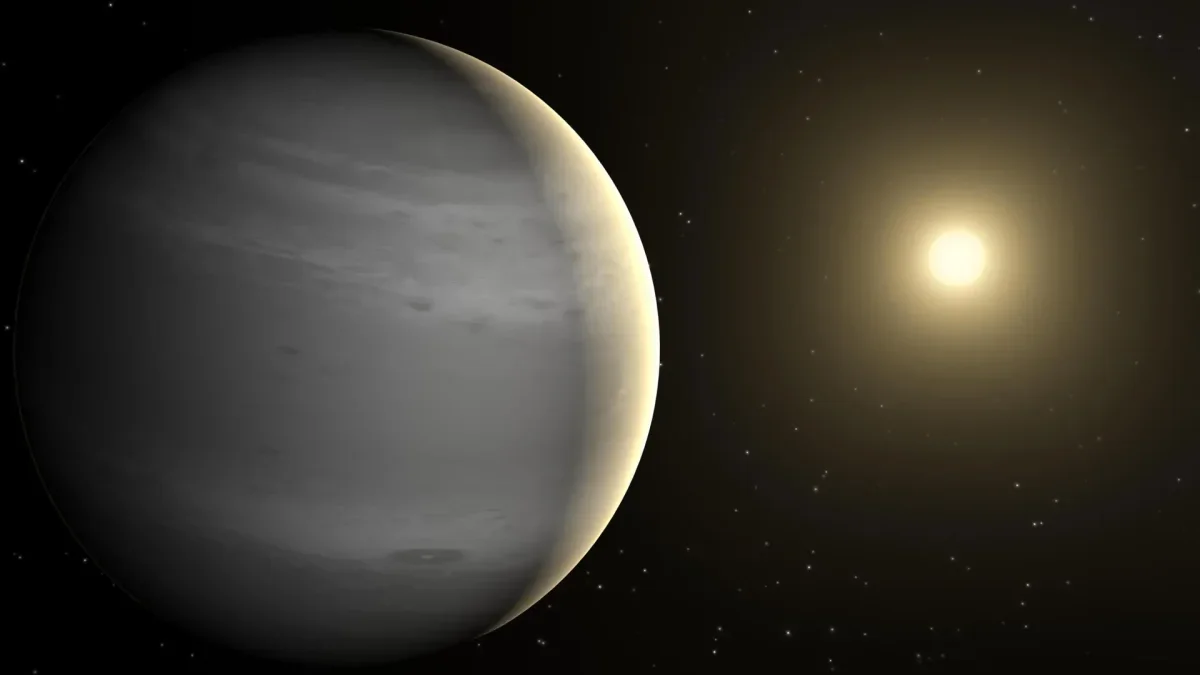
The recent discovery of TOI-199b is a remarkable achievement in the exploration of exoplanets, particularly because it defies the typical temperature extremes associated with giant planets. In our own solar system, for instance, Jupiter and Saturn are known for their frigid temperatures, while many distant exoplanets, often referred to as "hot Jupiters," orbit perilously close to their stars, resulting in scorching conditions.
TOI-199b, however, occupies a unique niche as one of the few temperate giant planets identified to date. This groundbreaking study marks the first detailed examination of its atmosphere, offering insights that could reshape our understanding of planetary formation and atmospheric evolution.
This significant research was spearheaded by a team from Penn State and NASA's Jet Propulsion Laboratory (JPL), with findings published in the Astronomical Journal on May 20. Renyu Hu, an associate professor of astronomy and astrophysics at Penn State, emphasized the value of studying exoplanets to gain a broader perspective on planetary systems beyond our own. "Since the discovery of the first exoplanet in 1992, thousands have been identified, yet only a handful of temperate giants like TOI-199b exist," he stated.
A Planet with Mild Temperatures
Located over 330 light years away, TOI-199b completes an orbit approximately every 100 days. With an estimated temperature of around 175 degrees Fahrenheit, it stands out as significantly cooler than most known giant exoplanets. While this temperature is still high, it is considerably milder than the intense heat of hot Jupiters and much warmer than the icy gas giants within our solar system.
Analyzing the Atmosphere with JWST
The research team utilized transmission spectroscopy to investigate TOI-199b's atmosphere. This innovative method allows astronomers to analyze starlight filtered through a planet's atmosphere during its transit across its star. By separating the star's light into various wavelengths, JWST can identify specific elements absorbed by the atmosphere, creating a unique spectral fingerprint.
After gathering approximately 20 continuous hours of data to establish baseline light measurements, the team observed a seven-hour transit, significantly longer than those typically recorded for hot Jupiters. By comparing the light spectra during the transit to the baseline, researchers identified the gases present in the atmosphere.
Methane and Other Gases Detected
The analysis revealed the presence of methane in TOI-199b's atmosphere, confirming predictions made by existing models. Additionally, hints of ammonia and carbon dioxide were detected. Hu expressed optimism for future observations, stating, "Further research could clarify the abundance of these gases and enhance our understanding of how planets and their atmospheres evolve, including our own Earth."
This pioneering study not only sheds light on TOI-199b but also sets the stage for further exploration of temperate gas giants, potentially revealing shared characteristics among such planets.
The collaborative effort included scientists from Arizona State University, Johns Hopkins University, the Carnegie Institution for Science, the California Institute of Technology, and the University of California Santa Cruz. Funding for this research was provided by NASA through a grant from the Space Telescope Science Institute.