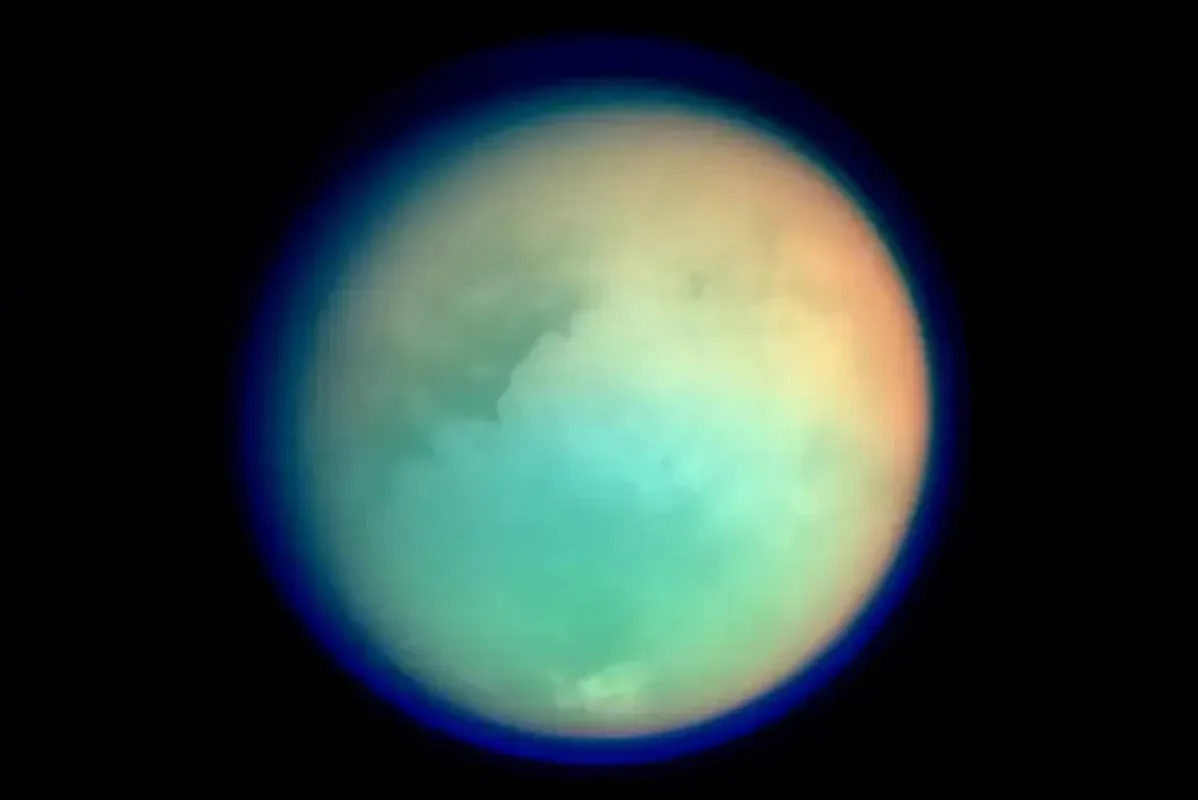
The James Webb Space Telescope has revealed a puzzling infrared signature on two distant worlds: Saturn's moon Titan and Pluto. Although these environments differ greatly, both share nitrogen-rich atmospheres with methane, a combination that can drive complex chemistry high above the surface.
Researchers led by Bruno Bézard of the Paris Observatory used Webb's NIRSpec and MIRI instruments to examine Titan through a clear infrared window near 5 micrometers. They found a narrow absorption feature centered around 5.1 micrometers, reducing the light by about 6 to 7 percent. The same pattern also appears on Pluto, though there it is broader and slightly weaker.
A Shared Signal, A Hidden Source
The signal seems to come from the surface rather than the atmosphere, but its origin remains unknown. It does not match laboratory spectra of compounds expected on either world. Scientists suspect it may involve a complex organic material, a substance altered by radiation and extreme cold, or a compound whose signature changes with grain size, temperature, or mixing conditions.
Titan is especially intriguing because it resembles Earth in some ways, with weather, clouds, dunes, rivers, lakes, and seas -- but built from methane and ethane instead of water. Pluto, meanwhile, is far colder and far thinner in atmosphere, yet its chemistry still echoes Titan's in surprising ways.
The next phase will combine wider Webb mapping with laboratory experiments on frozen candidate materials. Researchers will test whether any reproduce the same 5.113-micrometer fingerprint under Titan-like conditions. NASA's Dragonfly mission, planned for launch no earlier than 2028, could later provide direct surface measurements on Titan.
For now, the discovery adds a fresh layer of mystery to the outer solar system and points toward a future where telescopes, labs, and spacecraft work together to decode planetary chemistry.