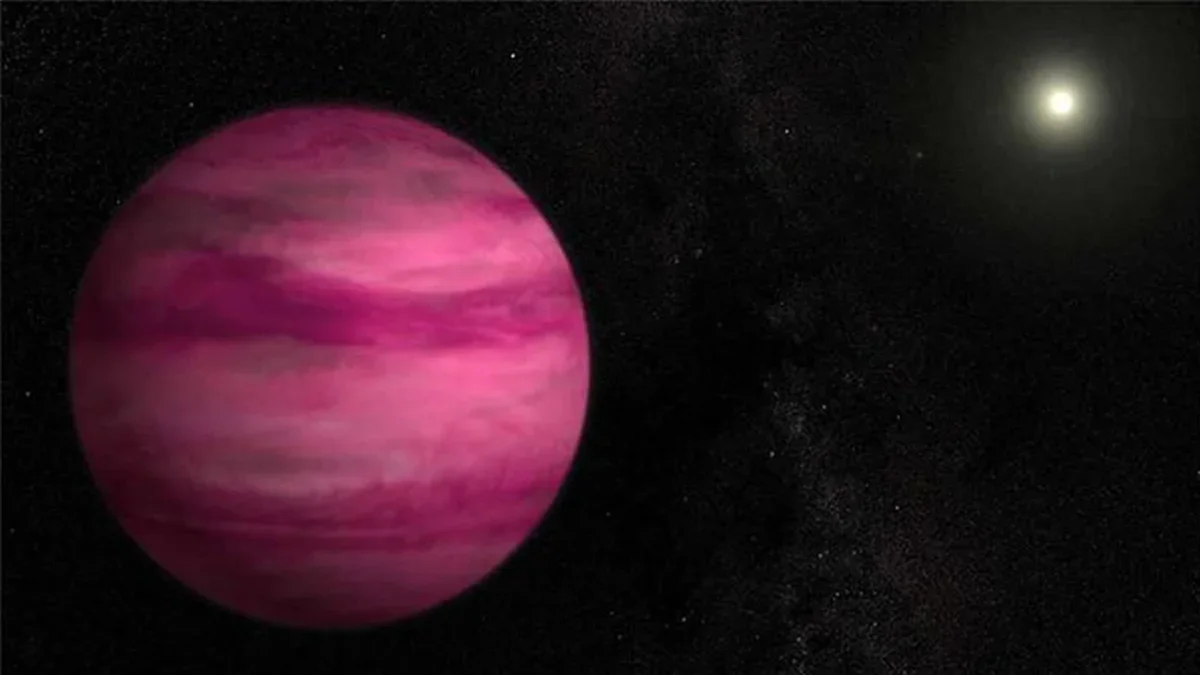
Researchers using the James Webb Space Telescope have uncovered the long-sought atmospheric signature of GJ504b, a cold planetary-mass companion nicknamed the Pink Planet. After earlier ground-based efforts fell short, JWST delivered the first detailed spectrum of the object and revealed a surprisingly complex atmosphere.
A rare look at a faint, distant world
GJ504b orbits a Sun-like star about 57 light-years away in Virgo and was first identified in 2013. With a mass estimated at roughly 25 times Jupiter's, it sits near the boundary between a giant planet and a brown dwarf, making it a valuable target for planetary science.
The new analysis, led by Northwestern University astronomer Aneesh Baburaj, suggests the object is far older than once thought, likely between 2.5 billion and 4 billion years old. That revised age helps explain its relatively cool temperature of about 290 degrees Celsius, which made earlier observations especially difficult.
What JWST found
By capturing infrared light with exceptional sensitivity, JWST detected water vapor, methane, carbon dioxide, and ammonia in the atmosphere. But the spectrum only made sense once the team tested cloud models that included salt clouds. Those clouds appear to scatter and absorb light in a way that reshapes the visible chemical signals.
The result is a clearer picture of how cold, faint worlds can look very different from standard atmospheric expectations. It also strengthens the idea that salt-based clouds may be a key feature in some distant planetary atmospheres.
GJ504b still leaves room for debate about its exact nature, and future JWST observations could help determine whether it is best classified as a giant planet or a brown dwarf-like object. The study appears in The Astronomical Journal.
As telescope technology advances, discoveries like this may redefine how scientists read the atmospheres and origins of worlds beyond our solar system.