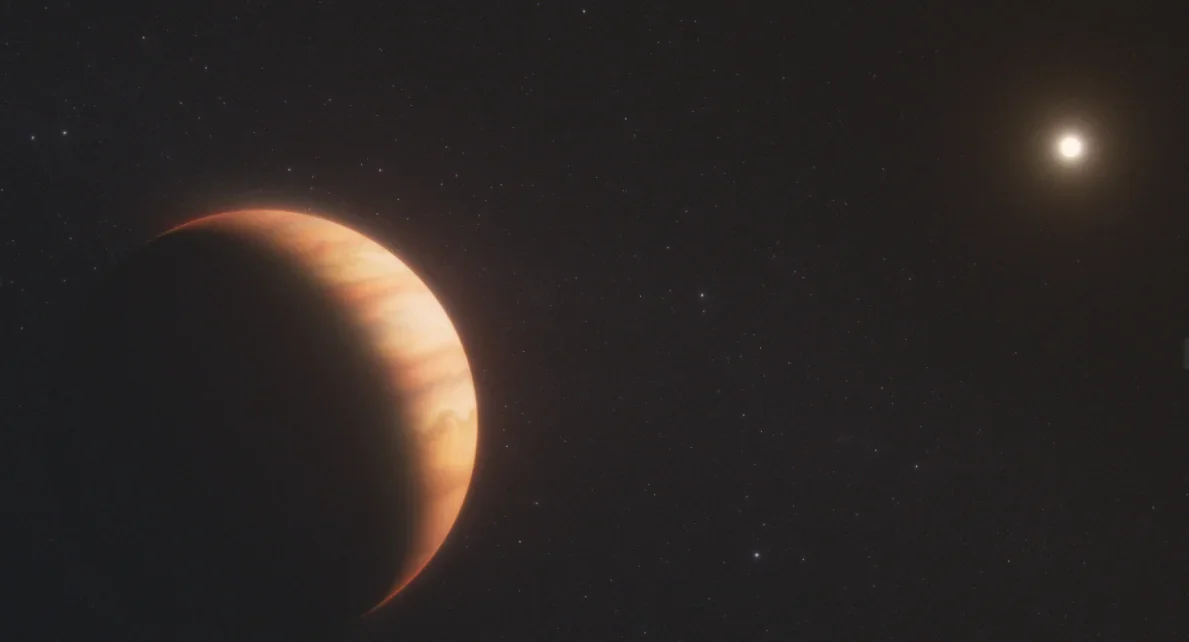
Astronomers have identified an unusual planet that appears to have endured the death of its star and later moved into an extreme orbit. The world, known as WD 1856 b, is slightly larger than Jupiter yet circles a white dwarf roughly the size of Earth about every 1.4 days.
The system sits around 80 light-years away and stands out because the planet is far larger than its stellar remnant. Researchers from the University of St Andrews and Northwestern University used the James Webb Space Telescope to study the planet as it passed in front of the white dwarf, a transit that lasted just eight minutes.
The Webb data revealed clues about the planet's atmosphere, including methane, clouds or hazes, and other hydrocarbons. The team also estimated that WD 1856 b is between four and 11 times the mass of Jupiter and has a temperature of about 400 Kelvin, warmer than expected from the faint light of the dead star alone.
That extra heat suggests the planet was reheated in the past, likely after its host star had already become a white dwarf. The leading idea is that WD 1856 b once orbited farther out, then gradually shifted inward through gravitational interactions with other bodies in the system, possibly within a triple-star arrangement. As it moved closer, tidal forces may have warmed it before it began cooling again.
Published in Nature, the study offers a rare look at how giant planets can behave after a sun-like star reaches the end of its life. It also gives scientists a valuable model for understanding what may eventually happen in our own solar system, when the Sun becomes a white dwarf billions of years from now.
Beyond its cosmic novelty, WD 1856 b shows that planetary systems can keep evolving long after a star's active life ends, opening a new frontier for white dwarf research and future exoplanet studies.