In January 2025, a powerful ripple in spacetime reached the twin detectors of the Laser Interferometer Gravitational-Wave Observatory in Washington and Louisiana almost simultaneously. The signal, known as GW250114, came from the collision of two black holes with masses of about 34 and 32 times the Sun.
Researchers say the event produced the clearest gravitational-wave signal ever recorded, offering a sharper look at what happens when black holes merge. Compared with the landmark 2015 detection, this one was roughly three times cleaner, giving scientists a rare opportunity to study the aftermath in greater detail.
Using that signal, a team has now extracted direct information from the newly formed black hole's event horizon -- the invisible boundary beyond which nothing can return. Instead of observing it with light, the scientists analyzed the gravitational waves left behind by the merger.
The key insight came from the black hole's brief "ringdown," a phase in which the remnant vibrates like a struck bell before settling into a stable form. Hidden inside that pattern was a faint feature called a direct wave, which appears to carry clues about the horizon's rotation and the strength of gravity near it.
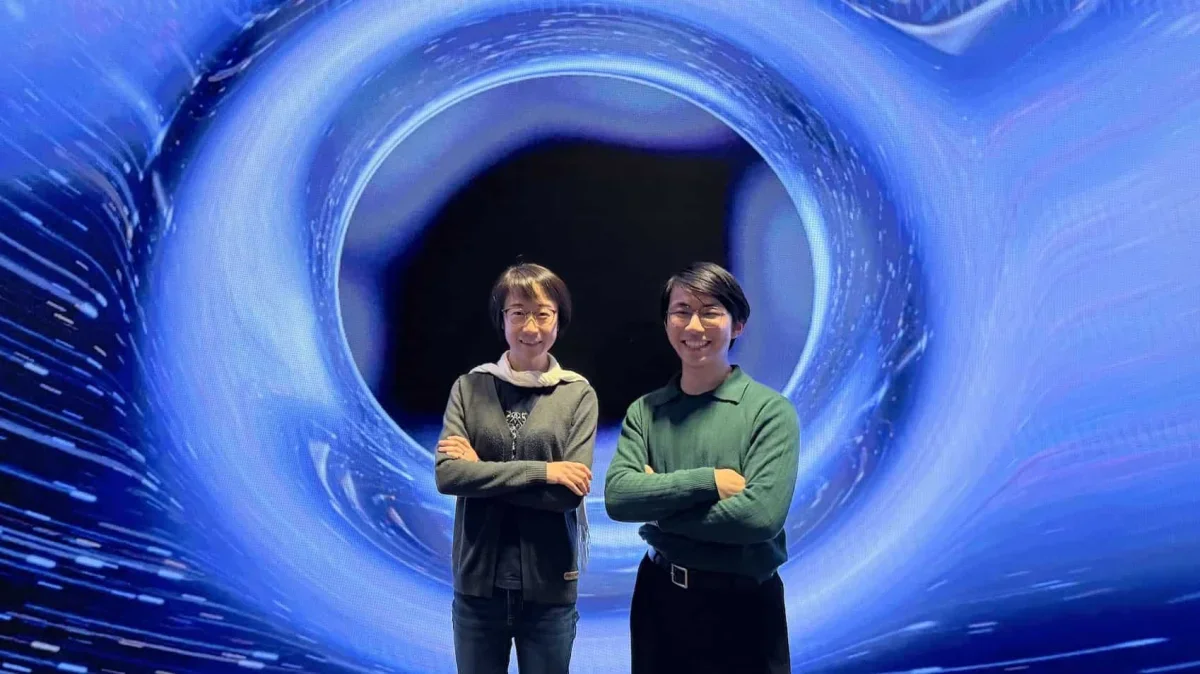
Neil Lu of the Australian National University's Centre for Gravitational Astrophysics and OzGrav said the team was able to isolate this subtle component and pull out information from close to the horizon. Co-author Ling Sun added that the result may help scientists better understand frame dragging, the effect in which a spinning black hole pulls spacetime around with it.
The measurements also provide a fresh test of general relativity in one of the universe's most extreme environments. So far, the results remain consistent with Einstein's predictions for a rotating black hole.
GW250114 was especially useful because it was nearby, strong, and well matched to LIGO's most sensitive frequency range. As gravitational-wave observatories continue to improve worldwide, this method could open a new era in black-hole research, where scientists study not only mergers but the physics of the horizon itself. The findings were published in Nature. This progress may help shape a future where black holes become readable cosmic laboratories.