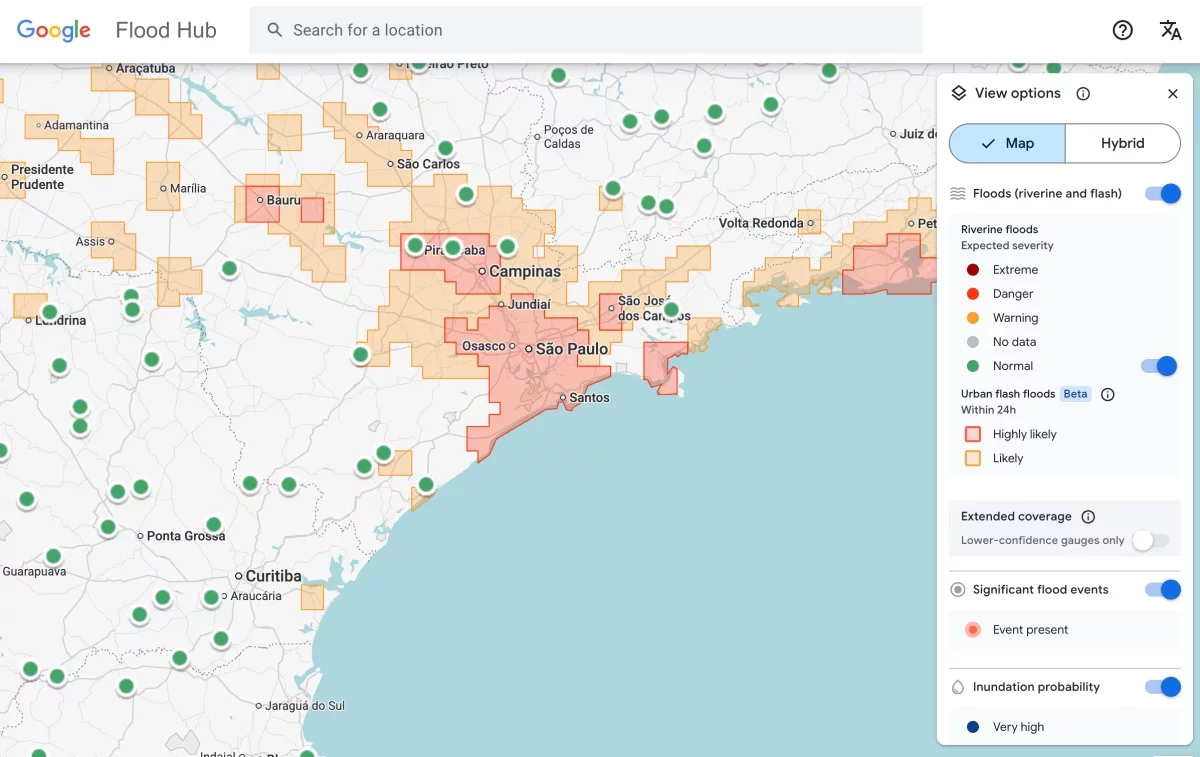
Flash floods, notorious for their rapid onset and devastating impact, claim over 5,000 lives annually, making accurate prediction a critical challenge. Google has embarked on an innovative approach to tackle this issue by harnessing the power of artificial intelligence and historical news reports.
Traditional weather data collection often falls short for flash floods due to their brief and localized nature, unlike more stable weather phenomena such as temperature or river flow. This gap has limited the effectiveness of deep learning models in forecasting these sudden events. To bridge this divide, Google researchers turned to Gemini, the company's advanced large language model, to analyze a staggering 5 million news articles worldwide. This effort identified and cataloged reports of 2.6 million distinct flood events, culminating in a geo-tagged time series known as "Groundsource." This marks a pioneering application of language models for such analytical tasks, as noted by Gila Loike, a product manager at Google Research.
Utilizing Groundsource as a foundational dataset, the team developed a forecasting model based on a Long Short-Term Memory (LSTM) neural network. This model integrates global weather forecasts to assess the likelihood of flash floods in specific regions.
Currently, Google's flood forecasting model is operational across urban areas in 150 countries, accessible via the Flood Hub platform. It provides crucial data to emergency response teams globally. António José Beleza, an official from the Southern African Development Community, highlighted the model's effectiveness in expediting flood response efforts.
Despite its advancements, the model has limitations, including a relatively low resolution that assesses risks over 20-square-kilometer areas. Additionally, it lacks the precision of the US National Weather Service's flood alert system, primarily because it does not incorporate local radar data for real-time precipitation tracking.
However, the initiative is designed to support regions where local governments may not have the resources to invest in sophisticated weather-sensing technologies or extensive meteorological records.
Juliet Rothenberg, a program manager on Google's Resilience team, emphasized the significance of aggregating millions of reports, stating that Groundsource helps to balance the informational landscape, allowing extrapolation to areas with limited data.
Looking ahead, Rothenberg expressed optimism that this methodology could extend beyond flash floods to other transient phenomena, such as heat waves and landslides, by creating quantitative datasets from qualitative sources.
Marshall Moutenot, CEO of Upstream Tech, which utilizes similar deep learning techniques for river flow predictions, remarked on the growing movement to compile data for AI-driven weather forecasting. He noted the creative nature of Google's approach in addressing the challenges of data scarcity in geophysics.
As technology continues to evolve, the potential for enhanced predictive capabilities in weather forecasting could significantly improve disaster preparedness and response, ultimately saving lives and protecting communities from the impacts of flash floods.