What does it truly mean to experience love during challenging times? This question, often overlooked in discussions about the medieval era, remains profoundly relevant today. While the Middle Ages may seem distant, their cultural narratives provide insights into love that resonate with contemporary life. In times of crisis, the essence of love is often revealed most clearly, especially when care is compromised or obscured.
In our current age, we face various forms of fatigue that hinder our ability to focus: humanitarian crises reduced to mere statistics, social care systems weakened by budget cuts, and digital environments that prioritize speed over responsibility. Care is not absent; rather, it is often postponed, obscured by scale and a prevailing notion that vulnerability must be managed rather than embraced.
Medieval European art frequently revisits themes of struggle and trial, often portraying them through the lens of blackness. Images of Black figures in Western art are not uncommon, yet they rarely convey love in its most expansive form. In representations of figures like Saint Maurice, blackness serves as a point of moral recognition, urging viewers to confront their own shortcomings. Similarly, figures such as Balthazar often use blackness to signify distance or universality, rather than exploring it as an intrinsic quality. These depictions invite self-reflection but typically fall short of presenting blackness as a source of love itself.
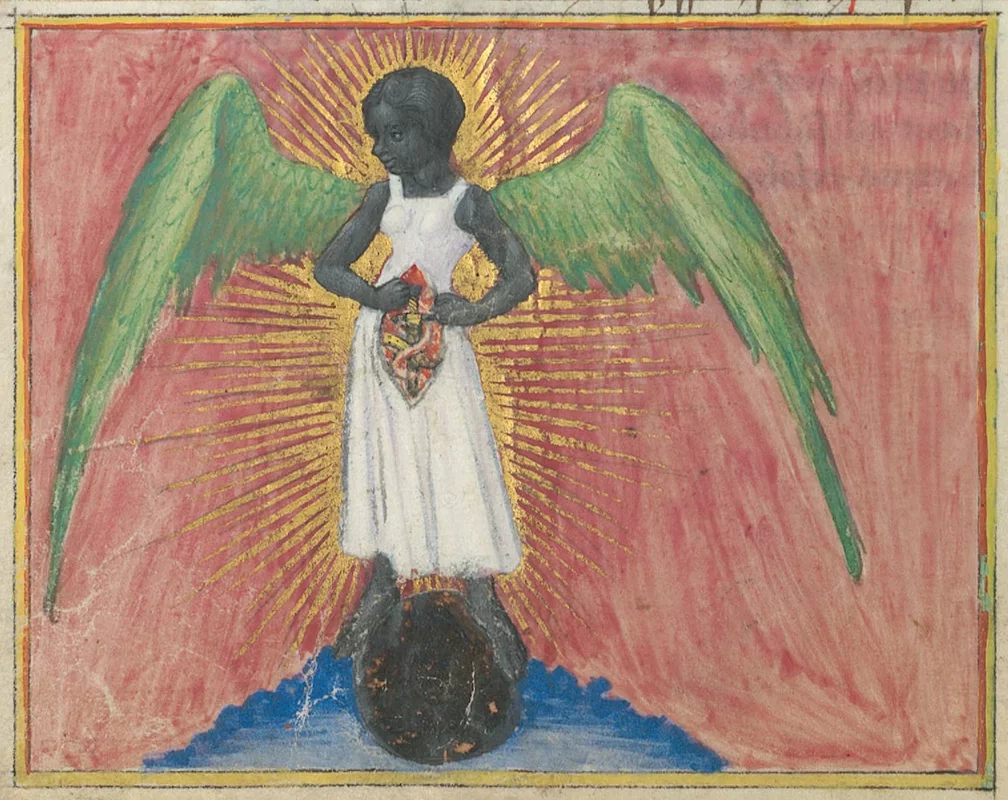
A striking image from the 15th-century alchemical manuscript Aurora consurgens challenges this perspective: it features a black angel with green wings and an open body revealing a radiant red interior. Traditionally, moral goodness in medieval theology was associated with light and whiteness, as articulated by theologians like Pseudo-Dionysius the Areopagite. This framework shaped centuries of Christian thought regarding purity and visibility, where white garments and light skin symbolized innocence and sanctity.
However, this angel, embodying these virtues, presents a different narrative. Her black skin, juxtaposed with the inner light, disrupts conventional notions of goodness. What form of love can emerge from such a representation?
The Aurora consurgens manuscript combines intricate prose with vivid imagery, guiding readers through a transformative journey. Attributed to a pseudo-Aquinas, it redefines alchemy as a spiritual practice focused on humility and self-awareness. The stages of nigredo, rubedo, and albedo represent phases of spiritual evolution, not merely a linear progression from darkness to light. Nigredo signifies a state of contrition, while rubedo intensifies this condition through inner transformation, and albedo represents a delicate receptivity rather than a final destination.
Importantly, the text cautions that whiteness can be misleading if disconnected from its origins. Transformation does not imply the erasure of blackness but rather its integration into a renewed inner life capable of embracing love.
Throughout the manuscript, angels and bodies symbolize inner states, positioning this black angel as part of a broader visual narrative focused on becoming rather than achieving perfection. To envision nigredo as the angel's skin translates a spiritual condition of humility into a tangible human experience. In the late Middle Ages, skin was seen as revealing character and inner disposition, and this portrayal emphasizes that nigredo is not a temporary stain but a fundamental aspect of being.
In medieval thought, blackness was not merely an identity marker but a complex symbol of repentance and salvation. Scholars have shown that black skin often served as a canvas for moral recognition, inviting viewers to confront their own spiritual vulnerabilities. Yet, traditionally, blackness has been viewed as static, a mark of sin awaiting purification.
What sets the Aurora consurgens apart is that it does not erase blackness in the transformation process. Instead, it redefines love as a capacity that emerges only after the self has been deconstructed. This black angel exemplifies a love that is not contingent upon overcoming blackness but is rooted in it.
This medieval image suggests that the soul's perceived "darkness" is not a barrier to transformation but rather the foundation for it. Acknowledging that we all carry a form of blackness does not negate historical differences; instead, it highlights a shared journey through vulnerability, which is essential for genuine love. In a time marked by turmoil and a lack of empathy, this image encourages us to view love as something that flourishes in vulnerability rather than purity.