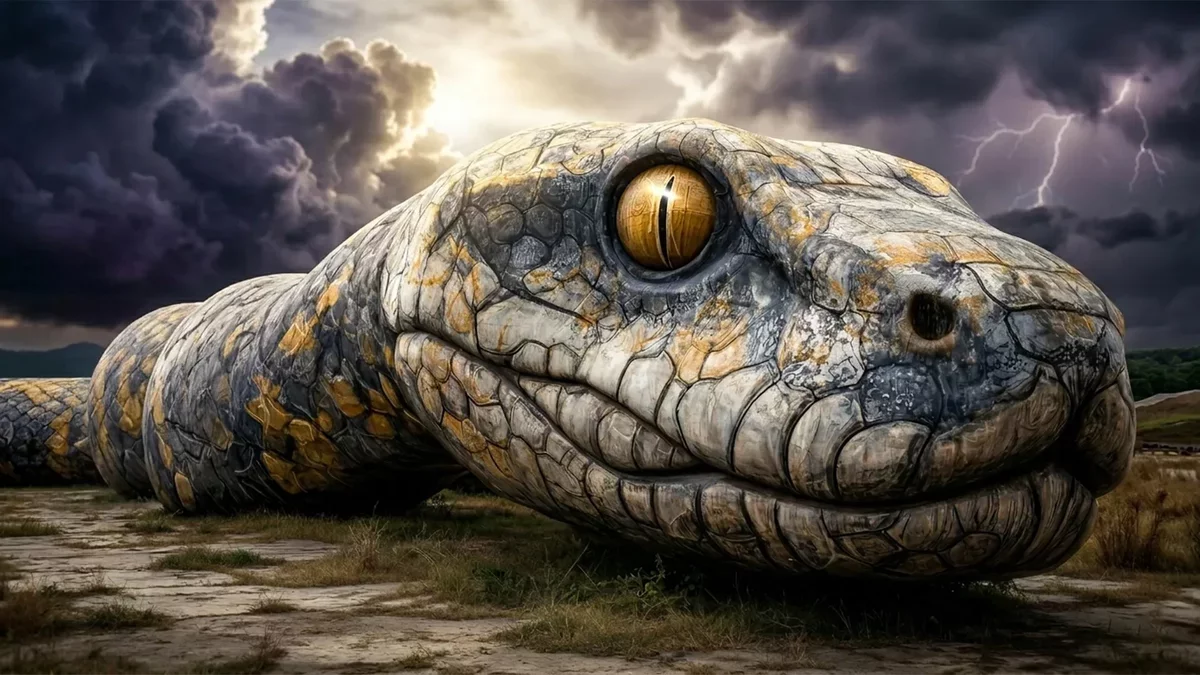
Researchers Debajit Datta and Sunil Bajpai have unveiled a remarkable fossil specimen from the Panandhro Lignite Mine in Kutch, Gujarat, India. This ancient snake, named Vasuki indicus, dates back approximately 47 million years to the Middle Eocene period. The name pays homage to the legendary serpent linked to the Hindu god Shiva, as well as the location of the discovery.
The fossil comprises 27 vertebrae, many of which are well-preserved and still connected, suggesting they belonged to a fully mature snake. These bones provide vital insights into the size and anatomy of this prehistoric creature.
Colossal Size Estimates
Measurements of the vertebrae range from 37.5 to 62.7 millimeters (1.48 to 2.47 inches) in length and 62.4 to 111.4 millimeters (2.46 to 4.39 inches) in width, indicating a robust, cylindrical body. Based on these dimensions, scientists estimate that Vasuki indicus could have measured between 10.9 and 15.2 meters (35.8 to 49.9 feet) in length.
This places Vasuki indicus in a similar size category as Titanoboa, the largest snake known to have existed, although researchers acknowledge some uncertainty in these size estimates. Given its substantial size, it is believed that this snake was likely slow-moving and employed ambush strategies, akin to modern-day anacondas.
Ancient Lineage and Geographic Spread
Vasuki indicus is classified within the madtsoiidae family, a lineage of snakes that thrived for nearly 100 million years, from the Late Cretaceous to the Late Pleistocene. This family was widespread, inhabiting regions across Africa, Europe, and India.
The findings suggest that Vasuki indicus may represent a lineage of large madtsoiid snakes that first emerged in India, subsequently dispersing into southern Europe and Africa during the Eocene epoch, which lasted from approximately 56 to 34 million years ago.
This discovery not only enriches our understanding of ancient serpents but also highlights the evolutionary pathways of reptiles and their geographical distribution over millions of years, providing a fascinating glimpse into our planet's distant past.