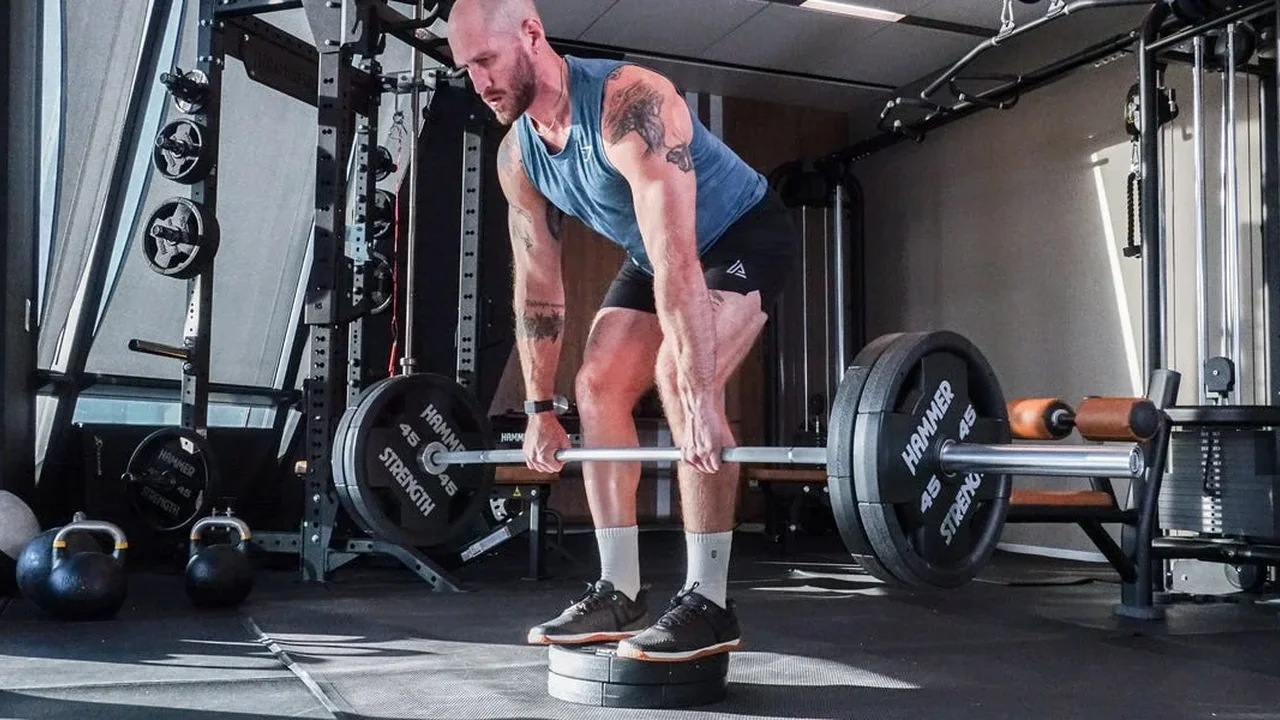
Raising your stance by an inch or two can make a familiar strength exercise more demanding. The deficit deadlift follows the same basic movement as a conventional deadlift, but the elevated starting position extends the distance the bar travels.
Why add a deficit?
The longer range of motion challenges the muscles involved in initiating the lift, particularly the quadriceps and glutes, while also asking for more hip and ankle mobility. A small study involving 20 experienced lifters found greater quadriceps and glute engagement during deficit deadlifts than during conventional deadlifts. That finding measures muscle activity, however, rather than proving greater long-term muscle growth.
The variation may help lifters who want to strengthen the first part of their pull or add range of motion to their training. But it is not suitable for everyone: if reaching the bar causes your lower back to round excessively or your hips to rise before the bar moves, build your conventional deadlift control and mobility first.
How to perform the lift
Use a stable platform and begin with a modest elevation of about one inch. Stand with the bar over the middle of your feet, grip it just outside your legs, and bend your knees into a controlled starting position. Brace your core, keep your arms straight, and drive through your feet to lift.
Keep the bar close to your legs as it travels upward. Once you are standing tall, push your hips back and bend your knees to lower the weight under control. Reset between repetitions rather than bouncing the bar into the next pull.
Start light and progress gradually
Because the extended range makes the lift harder, begin with less weight than you use for conventional deadlifts. Around 75-80% of your usual working weight can be a starting point; adjust to maintain sound technique. Two or three sets of three to five repetitions once a week is one way for newer lifters to introduce the variation. More experienced lifters may use it in a focused training block.
Keep the platform low at first, and increase weight or repetitions gradually instead of chasing a bigger deficit. Used thoughtfully, this variation can broaden strength training options and help lifters refine how they build force from the floor.