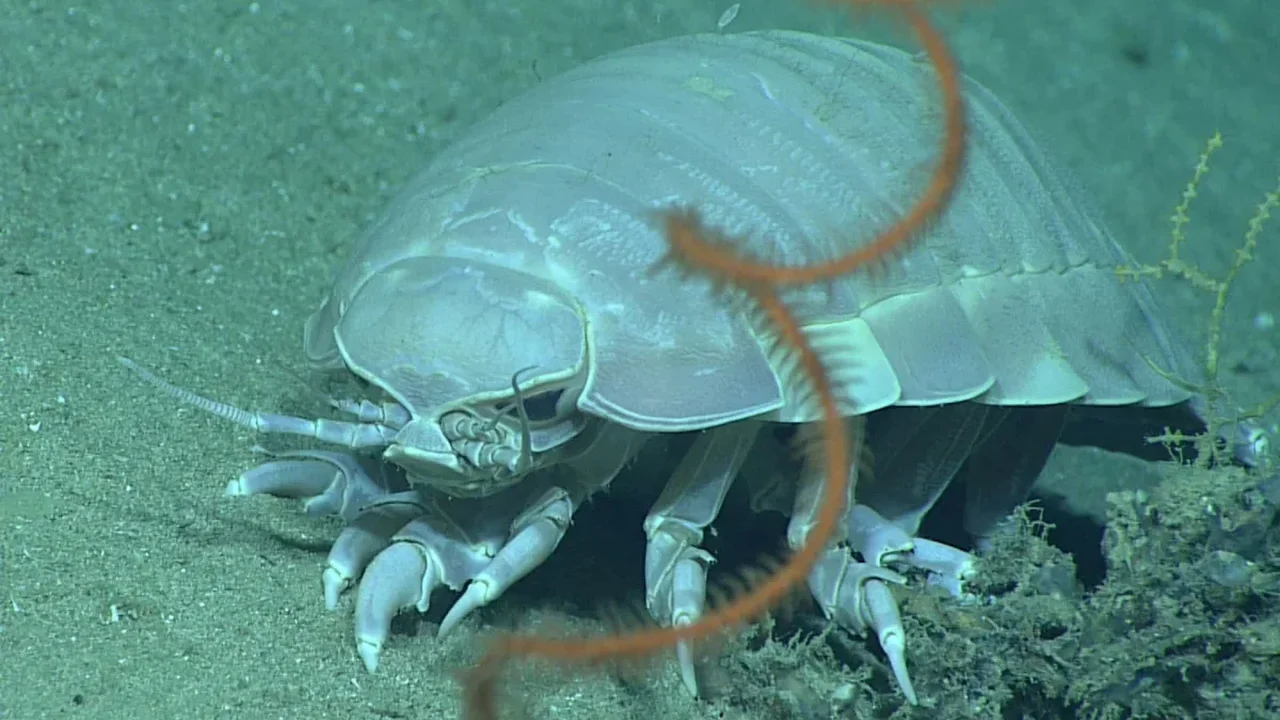
Scientists have uncovered an extraordinary survival system in the giant deep-sea isopod, a crustacean relative that can grow larger than a foot and endure long stretches without eating. In a new study, researchers found that the animal can survive for more than five years without food by combining a highly efficient digestive structure with a borrowed bacterial gene.
A body designed for scarcity
The deep ocean is one of Earth's most food-limited environments, so large animals there must make every meal count. The study shows that the supergiant isopod uses a feast-or-famine strategy: when food appears, it eats heavily, then stores and processes nutrients slowly over time.
Researchers compared Bathynomus jamesi, a supergiant species living near 898 meters deep, with the smaller Bathynomus doederleini, which lives at around 300 meters. They examined anatomy, metabolism, genomes, and gut microbes to understand why the deeper species can go so long without feeding.
One key finding was an unusually enlarged stomach in B. jamesi, which can occupy nearly two-thirds of the body cavity in large individuals. This expanded storage space helps the animal hold and digest large meals gradually. A captive specimen reportedly consumed 2.6 kilograms of food in one sitting.
The role of a microbial gene
The team also identified a gene called ND1, which appears to have entered the isopod lineage through horizontal gene transfer from microbes. Over time, the gene was duplicated and became highly active. Its behavior is also shaped by epigenetic control through histone acetylation.
When the researchers inserted ND1 into zebrafish, nematodes, and cultured cells, the gene showed a striking effect under cold conditions similar to the deep sea. It reduced energy-production activity and helped the test organisms conserve fuel during starvation. In zebrafish, survival without food increased by about 37 percent in cold settings.
Together, these findings point to a two-layered adaptation: store more energy when possible, then spend far less of it afterward. The study also suggests that gene borrowing from microbes may have played a larger role in animal evolution than previously recognized. In the future, this kind of research could reshape how scientists understand survival, metabolism, and adaptation in extreme environments.