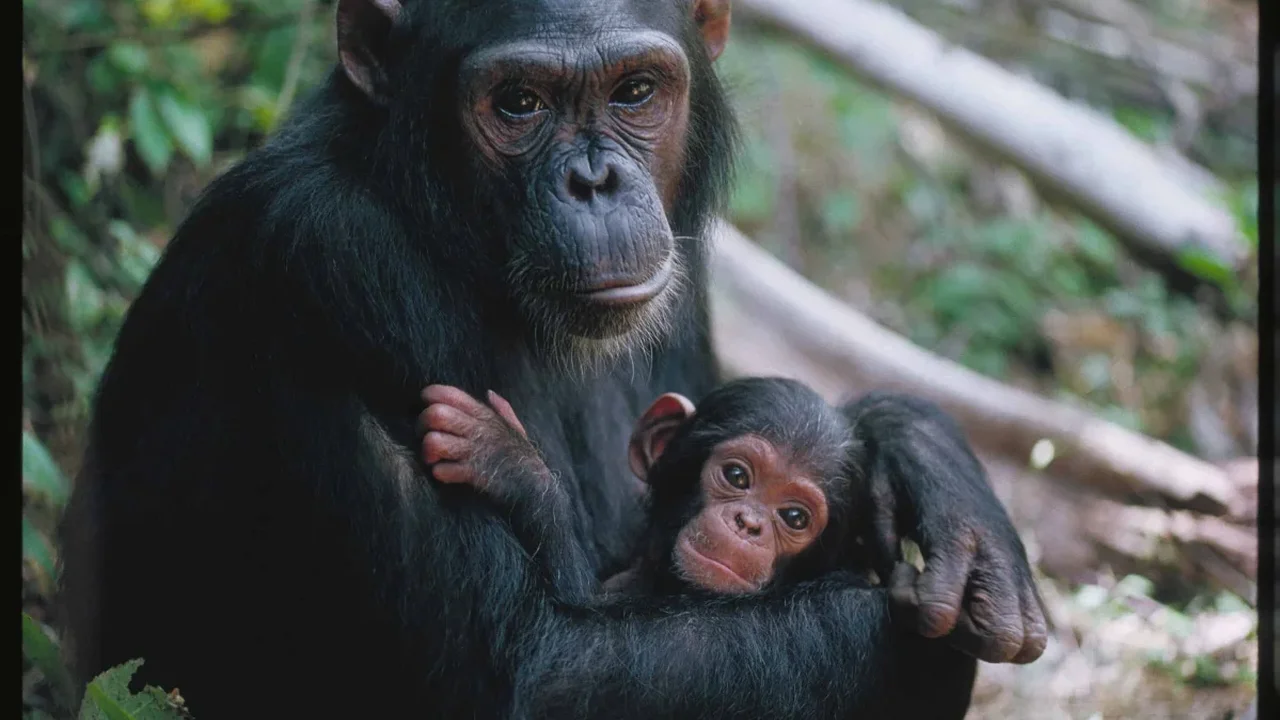
Wild western chimpanzees in Senegal may do more than learn by watching: new research suggests that experienced individuals, especially mothers, can actively help infants acquire essential tool-use skills.
Scientists from the University of Barcelona and the Jane Goodall Institute Spain examined chimpanzee behavior in Dindefelo, Senegal, focusing on how tools and food items move between individuals during foraging. Their findings indicate that these exchanges can support young chimpanzees as they learn complex techniques.
Learning Through Guided Access
The team documented 33 tool transfers and four fruit transfers among western chimpanzees. Many of these exchanges involved adults passing tools to infants, often within family groups. Mothers were particularly important, frequently providing their offspring with access to sticks used for collecting ants, algae, and termites.
In two especially detailed observations, older chimpanzees appeared to demonstrate a task before making the relevant object available to an infant. In one case, a mother prepared a stick at an ant nest, enabling her young to remove it and feed. In another, a juvenile demonstrated how to pound baobab fruit against stone before a younger chimpanzee successfully attempted the same technique.
A Window Into Animal Culture
Chimpanzees are already known for creating leaf sponges, shaping sticks and using stones in food-related tasks. However, the study, published in Frontiers in Psychology, adds evidence that social support may play a meaningful role in passing these skills between generations.
The researchers found that transfers were commonly made from skilled individuals to less experienced ones. This pattern suggests that chimpanzee learning can combine observation, practice and active guidance, rather than relying on individual discovery alone.
Understanding how chimpanzees share practical knowledge may offer fresh insight into the roots of technology, education and cultural transmission. As research expands, these observations could reshape how science understands the evolution of learning across species.