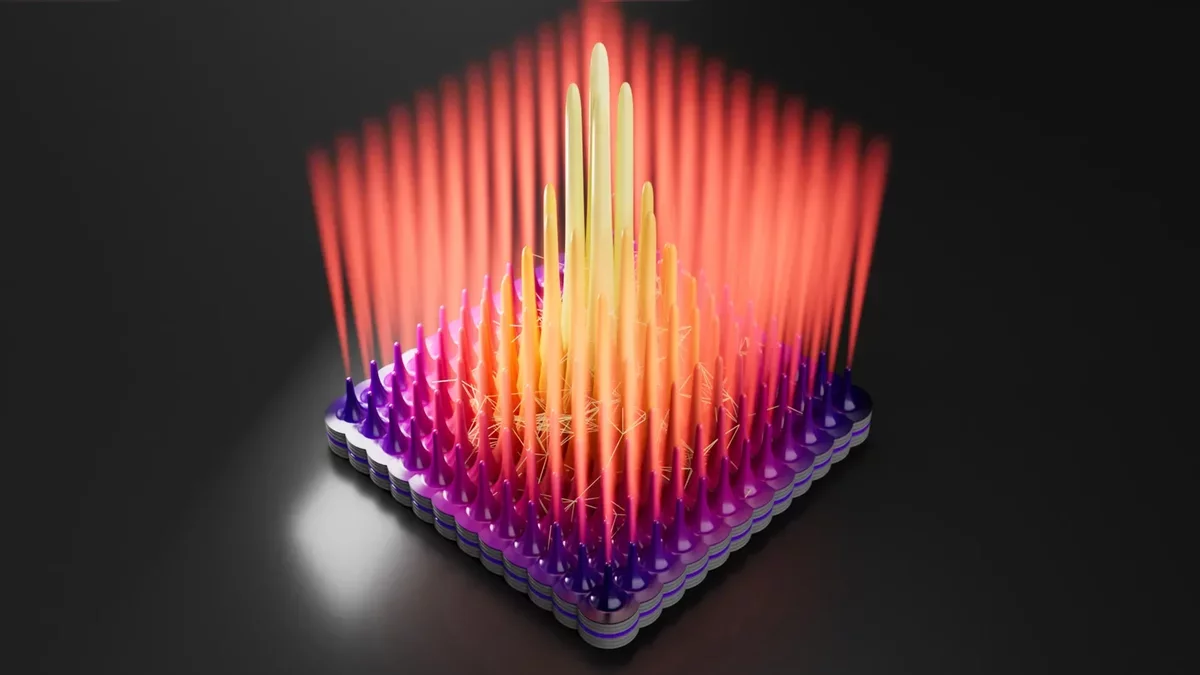
Researchers at the University of Würzburg have achieved a groundbreaking advancement in understanding growth processes, confirming the KPZ theory in two dimensions for the first time. This follows previous validations in one-dimensional systems, marking a pivotal moment in the exploration of universal growth models.
The Complexity of Growth Prediction
Siddhartha Dam, a postdoctoral researcher at the Würzburg-Dresden Cluster of Excellence ctd.qmat, explains the inherent challenges in predicting growth. "Growth processes of surfaces--ranging from crystals to bacteria--are characterized by their nonlinear and random nature. These systems are fundamentally out of equilibrium, making experimental verification difficult," he states. The team's success in controlling a non-equilibrium quantum system in the lab reflects recent technological advancements.
Creating a Controlled Quantum Environment
To validate the KPZ theory, the researchers engineered an intricate quantum setup, cooling a gallium arsenide (GaAs) semiconductor to a frigid −269.15°C while continuously stimulating it with laser light. This process led to the formation of polaritons--unique particles that are hybrids of light and matter, existing only under non-equilibrium conditions.
Polaritons, which vanish within picoseconds, provide an ideal medium for observing rapid growth phenomena. "We can accurately monitor the locations of polaritons in the material. As we pump the system with light, polaritons are generated and grow. Our advanced techniques allowed us to quantify their spatial and temporal evolution, confirming adherence to the KPZ model," Dam elaborates.
From Concept to Experimental Reality
The initiative to test KPZ behavior in such a system originated from Sebastian Diehl, a professor at the University of Cologne. His theoretical groundwork laid the foundation for this research in 2015. While a 2022 study in Paris confirmed KPZ predictions in one-dimensional systems, extending these findings to two dimensions posed significant challenges. The current results fill this critical gap.
"The experimental validation of KPZ universality in two-dimensional systems underscores the fundamental nature of this equation in real-world non-equilibrium scenarios," Diehl remarks on the accomplishments of the Würzburg team.
Engineering Precision in Material Design
A crucial aspect of this breakthrough was the meticulous engineering of the material. The researchers developed a sophisticated structure where mirror layers confine photons within a central "quantum film." Within this layer, photons interact with excitons in the gallium arsenide, resulting in observable polaritons as they evolve.
"By precisely controlling the thickness of material layers through molecular beam epitaxy, we fine-tuned their optical properties and fabricated highly reflective mirrors under ultra-high vacuum conditions," explains Simon Widmann, a doctoral researcher involved in the experiments. This level of control was vital for successfully demonstrating KPZ universality.