Researchers have made significant strides in laser technology, achieving a remarkable breakthrough that allows for the integration of ultrafast lasers onto a chip. Led by Professor Tobias J. Kippenberg at EPFL, this innovation marks the first instance of an integrated ultrafast laser that rivals the performance of traditional tabletop femtosecond lasers, as reported in Nature.
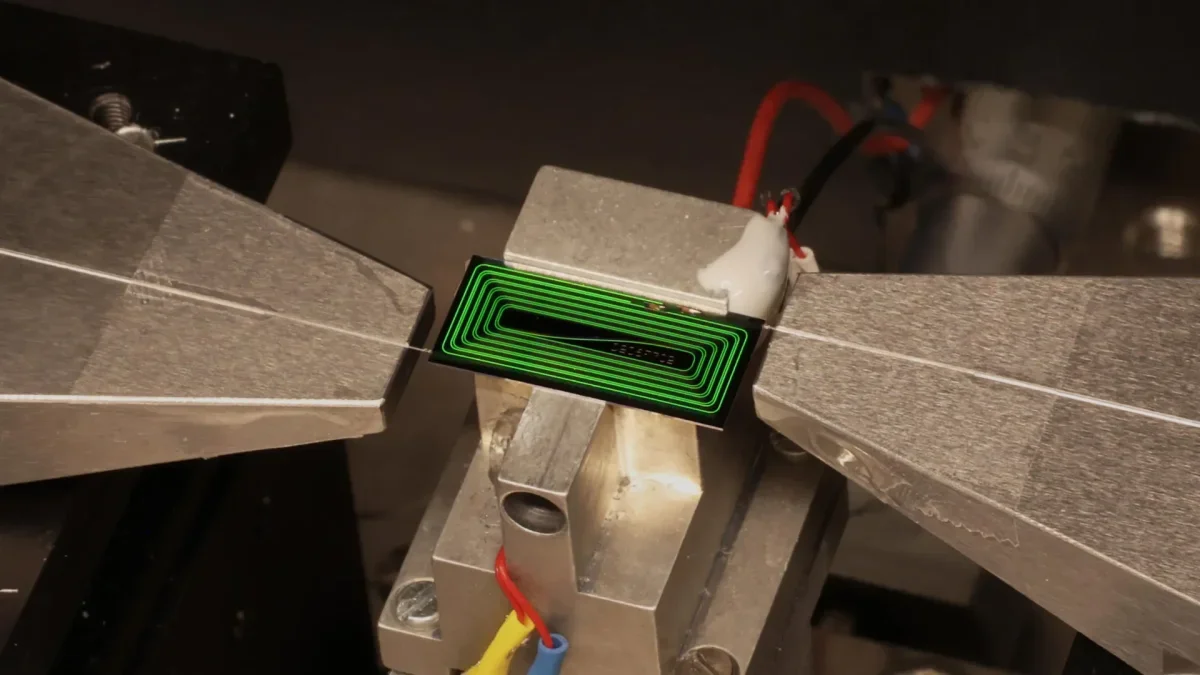
The newly developed device delivers pulse energies of 1.05 nanojoules with pulse durations as brief as 147 femtoseconds, all from a compact photonic chip. This advancement is set to revolutionize the field, as these lasers have historically been cumbersome and expensive, occupying large optical tables.
Revolutionizing Ultrafast Laser Technology
Photonic chips function by manipulating light through tiny structures known as waveguides, much like electronic chips direct electrical signals. These chips are already integral to telecommunications, having enabled the miniaturization of various optical technologies that once required bulky equipment.
"For over two decades, achieving a high-pulse-energy femtosecond laser on a chip was considered the holy grail of integrated photonics," Kippenberg states. "Our findings demonstrate not only its feasibility but also that it can be accomplished using a surprisingly elegant design that had previously been overlooked."
Innovative Design Achieves Milestone
The research team utilized a laser architecture known as the Mamyshev oscillator, which had not received much attention in the context of integrated photonics. This innovative system incorporates a nonlinear waveguide positioned between two optical filters, each transmitting different light spectrum portions. As an intense laser pulse traverses the waveguide, it expands into a wider array of colors, with part of this broadened pulse passing through both filters and circulating within the laser cavity.
Weaker light does not broaden sufficiently and is filtered out, enhancing the overall efficiency of the system. "This design is particularly appealing because it avoids components that are challenging to fabricate on the erbium-doped silicon nitride chip," explains co-author Zheru Qiu.
Moreover, the Mamyshev oscillator's design minimizes instability issues common in many laser architectures, making it exceptionally suitable for integrated photonic devices.
Compact Device, Expansive Applications
The laser cavity measures just 42 centimeters in length but can be condensed onto a chip the size of a match head, vastly reducing the size compared to conventional fiber-based ultrafast lasers. This compactness allows for wafer-scale manufacturing, potentially enabling the mass production of over 1,000 laser cavities simultaneously.
This manufacturing efficiency could drastically lower costs, making ultrafast lasers more accessible for applications in sensing, spectroscopy, and precision measurements. "With kilowatt-level peak powers, this chip can support demanding applications that have traditionally relied on large, costly laboratory lasers," Qiu adds.
The researchers envision that this technology could lead to portable, affordable devices for various applications, including environmental monitoring, material defect detection, and medical diagnostics. Furthermore, it may pave the way for compact optical atomic clocks, crucial for future advancements in communication and navigation systems.
This groundbreaking work involved collaboration between researchers from the EPFL Institute of Electrical and Microengineering and Helmholtz-Zentrum Dresden-Rossendorf (HZDR).