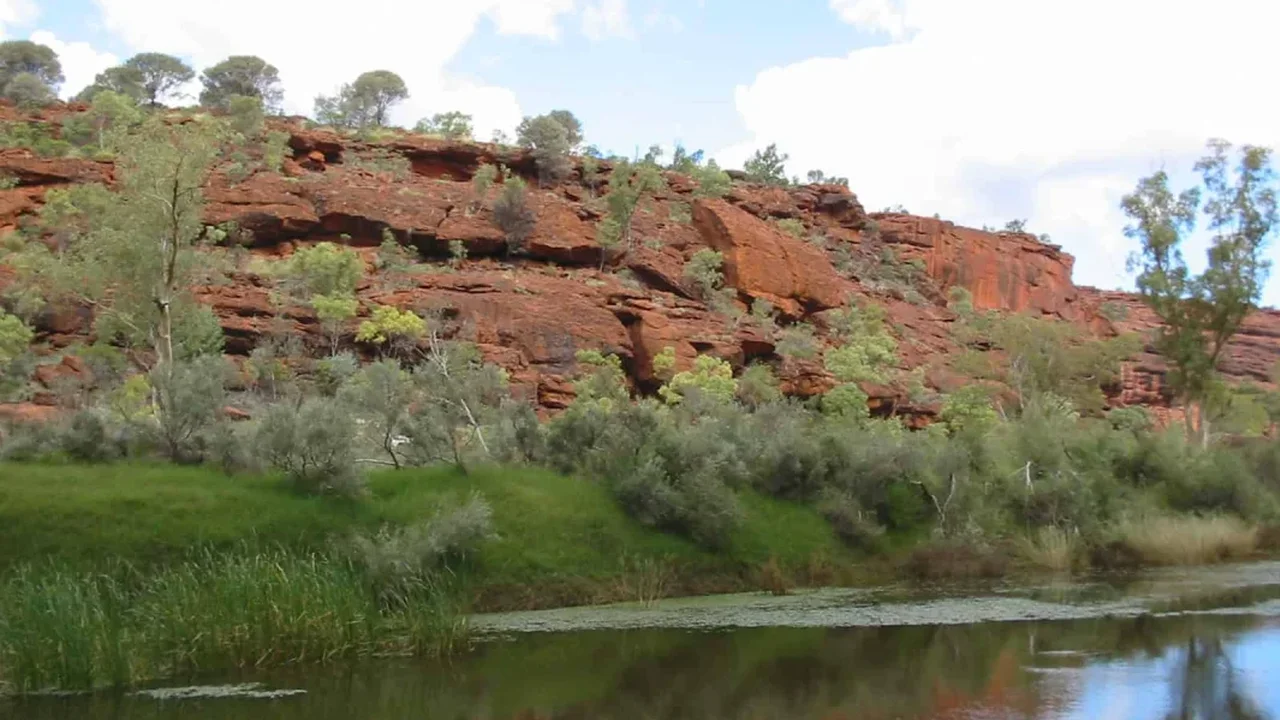
In central Australia, the Finke River--known as Larapinta to Arrernte people--stands out as a leading candidate for the world's oldest persistent river system. Geological evidence suggests its wider drainage corridor may have carried water for around 300 to 400 million years.
A river older than dinosaurs
The Finke rises near the MacDonnell Ranges and flows towards the Lake Eyre Basin. For much of the year, its course may appear as sandy channels and isolated waterholes. Seasonal rainfall, however, reactivates the system and sends water through the region's ancient gorges.
Its exceptional age is linked to its ability to cut through rising mountain ranges rather than being redirected around them. Geologists describe this as an antecedent river: a watercourse that existed before surrounding land was uplifted and continued eroding downward as the terrain changed.
The river's history is associated with the Alice Springs Orogeny, a long mountain-building phase that reshaped central Australia between roughly 450 million and 300 million years ago. Sediments in the nearby Amadeus Basin preserve evidence of ancient streams that once crossed this evolving landscape.
Reading a river's deep-time record
No modern river channel remains fixed for hundreds of millions of years. Rivers migrate, join new tributaries and leave former routes behind. Scientists therefore assess the longevity of a broader drainage corridor, rather than claiming that every present-day bend is equally ancient.
Near the Finke, remnants of former riverbeds can be found above the current channel. These gravel deposits were hardened by minerals such as iron and silica, allowing them to withstand erosion while surrounding material gradually wore away. This geological pattern offers clues to earlier versions of the river system.
Researchers build such timelines by studying sediment layers, terraces, gorge walls and minerals transported by water. Techniques including radiometric dating, luminescence analysis and isotope measurements help reconstruct when landscapes formed and how quickly rivers carved through them.
A rare survivor of continental change
Other long-lived systems, including the Meuse, New, Rhine, Save and Narmada rivers, also preserve ancient geological roots. Yet the Finke's continuity through major tectonic shifts gives it a particularly strong claim. Its origins may reach back to the era when Pangaea was assembling, long after the earlier formation of Gondwana.
The Finke River illustrates how landscapes can retain traces of Earth's distant past. Continued research into ancient drainage systems may sharpen our understanding of continental evolution, climate history and the resilience of natural corridors over deep time.