For decades, the rotation rate of Saturn has puzzled scientists, with measurements indicating that the planet's spin might be fluctuating. This intriguing phenomenon has now been clarified by researchers utilizing the James Webb Space Telescope (JWST).
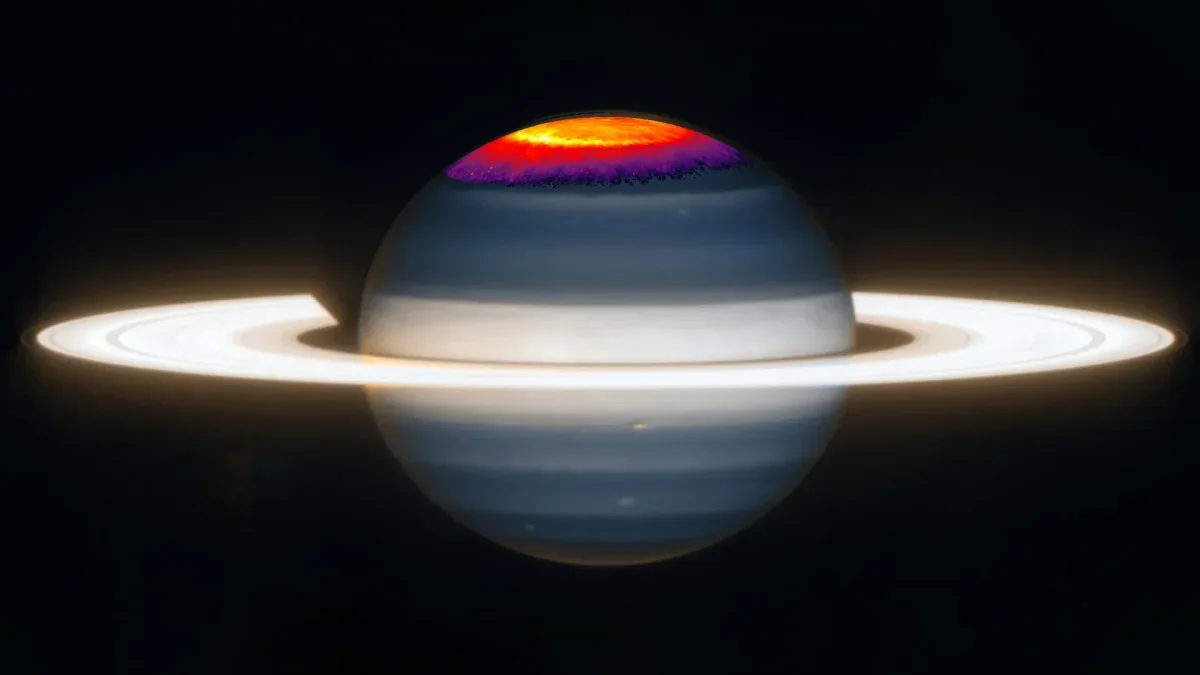
Recent findings, published in the Journal of Geophysical Research: Space Physics, highlight that Saturn's captivating northern lights are central to this mystery. The study reveals that the planet's auroras initiate a robust cycle involving heat, winds, and electrical currents, causing variations in its perceived rotational speed based on measurement techniques.
Decades of Inquiry
The quest to understand Saturn's rotation began in earnest after NASA's Cassini spacecraft observed potential changes in 2004. Such alterations in a planet's spin are atypical and prompted extensive investigation.
In 2021, a team led by Professor Tom Stallard from Northumbria University proposed a novel explanation, suggesting that the apparent changes in rotation were linked to atmospheric winds affecting electrical signals from Saturn's auroras. This insight clarified the misleading measurements but left one vital question: What drives these winds?
JWST's Groundbreaking Observations
To delve deeper, Stallard and a team of researchers from various institutions in the UK and US turned to the JWST. They meticulously observed Saturn's northern aurora over an entire Saturnian day, achieving unprecedented detail.
Focusing on infrared emissions from a molecule known as trihydrogen cation, which serves as a natural temperature indicator in Saturn's upper atmosphere, the researchers created the most detailed temperature and charged particle density maps of the auroral region to date. The accuracy of these measurements was significantly enhanced, allowing for the detection of subtle thermal patterns that were previously obscured.
A Self-Sustaining Cycle
The data collected aligned closely with predictions from long-standing computer models, indicating that Saturn's auroras do more than dazzle observers. The energy from these auroras heats specific atmospheric regions, generating winds that create electrical currents, effectively powering the auroras in a self-sustaining cycle.
Professor Stallard described this phenomenon as a "planetary heat pump," where the auroras heat the atmosphere, which in turn drives winds that produce currents to sustain the auroras.
Broader Implications
This discovery may extend beyond Saturn, suggesting that interactions between a planet's atmosphere and magnetosphere could be common across other celestial bodies. The researchers propose that understanding these dynamics could reshape our comprehension of planetary atmospheres as a whole.
Professor Stallard emphasized the significance of these findings, stating, "If a planet's atmospheric conditions can drive currents into the surrounding space environment, we may uncover interactions in other worlds that we have yet to imagine."
An International Collaborative Effort
The James Webb Space Telescope, a premier observatory, is a collaborative project led by NASA alongside the European Space Agency (ESA) and the Canadian Space Agency (CSA). The research was conducted by a coalition of experts from several universities, demonstrating the power of international collaboration in advancing our understanding of the cosmos.