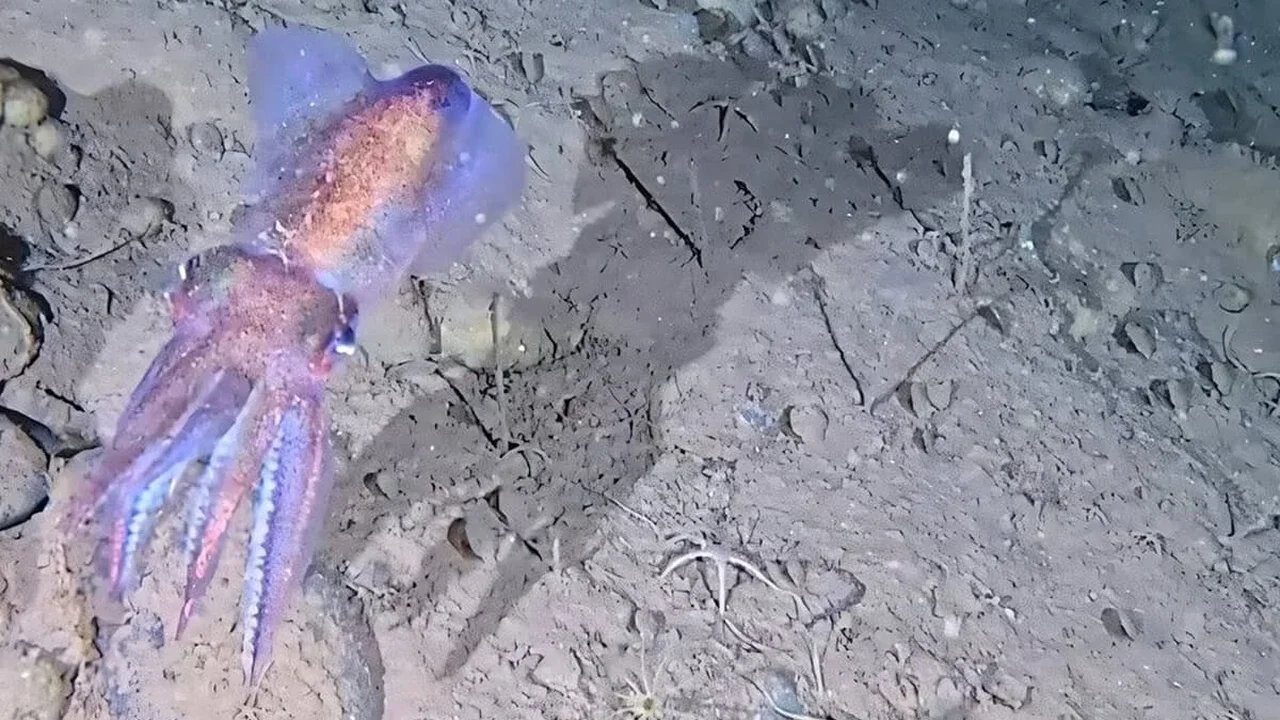
Researchers have captured the first in-the-wild footage of the Arctic bobtail squid, Rossia moelleri, deep inside a Greenland fjord. The mature female was seen near three clusters of eggs about 50 meters below the surface, offering a rare glimpse into life in one of the Arctic's least explored marine environments.
A rare Arctic breeding record
The observation took place during a September 2025 expedition in Kong Oscar Fjord, within Northeast Greenland National Park. Using a compact remotely operated vehicle equipped with a 4K camera, floodlights, and laser scales, the team documented the squid in water around -1.6°C. The animal measured roughly 10 centimeters long, while the egg clusters were estimated to contain about 50, 33, and 22 eggs.
Lead author Dr. Paige Maroni of the University of Western Australia said the record highlights how marine species can thrive in extreme conditions. The finding also confirms, for the first time, that Rossia moelleri reproduces in this remote fjord system.
Why the discovery matters
Bobtail squid are small cephalopods that play an important role in marine food webs as both hunters and prey. Because they have short life cycles, they can also serve as sensitive indicators of environmental change. In a region where underwater biodiversity remains sparsely documented, even one verified breeding site helps scientists build a clearer picture of Arctic ecosystems.
The study adds a new baseline for future surveys in Northeast Greenland National Park, an area that is rapidly changing as sea ice retreats and glaciers lose mass. It also shows how smaller research missions and low-impact technology can open access to places that are difficult for larger expeditions to reach.
Published in Polar Biology, the discovery strengthens our understanding of Arctic resilience and may help guide future marine research as the region continues to evolve.