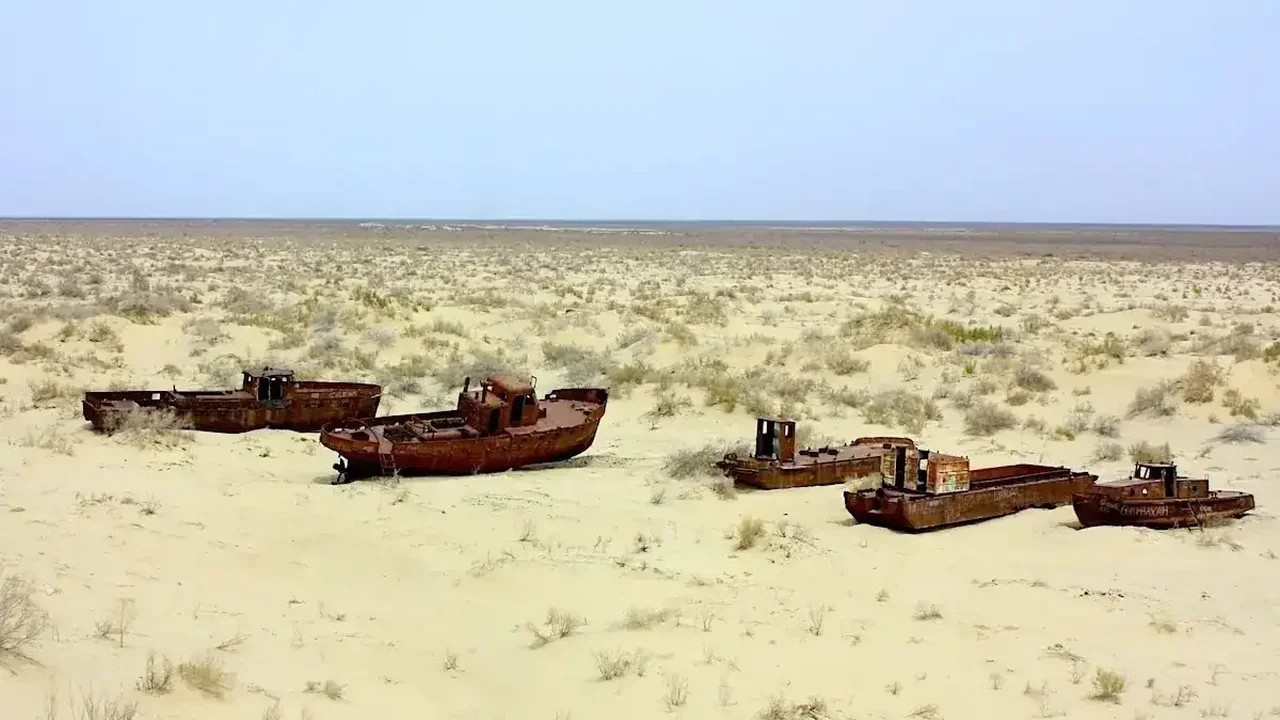
The Aral Sea, once among the world's largest inland lakes, has become a striking example of how shrinking waters can reshape the climate system. A new study published in Science shows that the lake's long retreat has not only transformed the landscape between Kazakhstan and Uzbekistan, but also released vast amounts of carbon into the atmosphere.
Researchers led by Rafael Marcé of the Centre for Advanced Studies in Blanes analyzed sediment across different zones of the former lakebed to track how carbon escaped as the water disappeared. Their estimate is substantial: from 1960 to 2022, the Aral Sea emitted about 748 million metric tons of carbon dioxide, a volume roughly equal to three times Spain's annual emissions.
The study highlights a key shift in inland waters. When lakes are full, organic material settles into sediments and acts as a carbon sink. Once the water recedes, that stored carbon can be released back into the air. The team also found that wind-driven dust played a major role, accounting for nearly a fifth of the emissions measured in the drying basin.
Beyond the past emissions, the researchers estimate that around 605 million metric tons of carbon dioxide may still remain in the exposed sediments. That makes the Aral Sea basin an important case study for climate science, but also a possible model for protecting carbon-rich lakebeds elsewhere. The paper points to similar drying systems such as Lake Chad, Lake Poopó, the Caspian Sea, the Salton Sea, and the Great Salt Lake.
Scientists say the findings open a new conversation about restoration, water management, and carbon accounting. Better irrigation systems, smarter water use, and climate incentives could help reduce pressure on vulnerable inland waters. In that sense, the Aral Sea may become a reference point for how science and policy can work together to protect hidden carbon stores and shape a more resilient future.