Antarctica has just two native flowering plants, and long-term field research shows they respond to warming in strikingly different ways. The findings, published in Physiologia Plantarum, come from experiments on Antarctic hair grass and Antarctic pearlwort on King George Island.
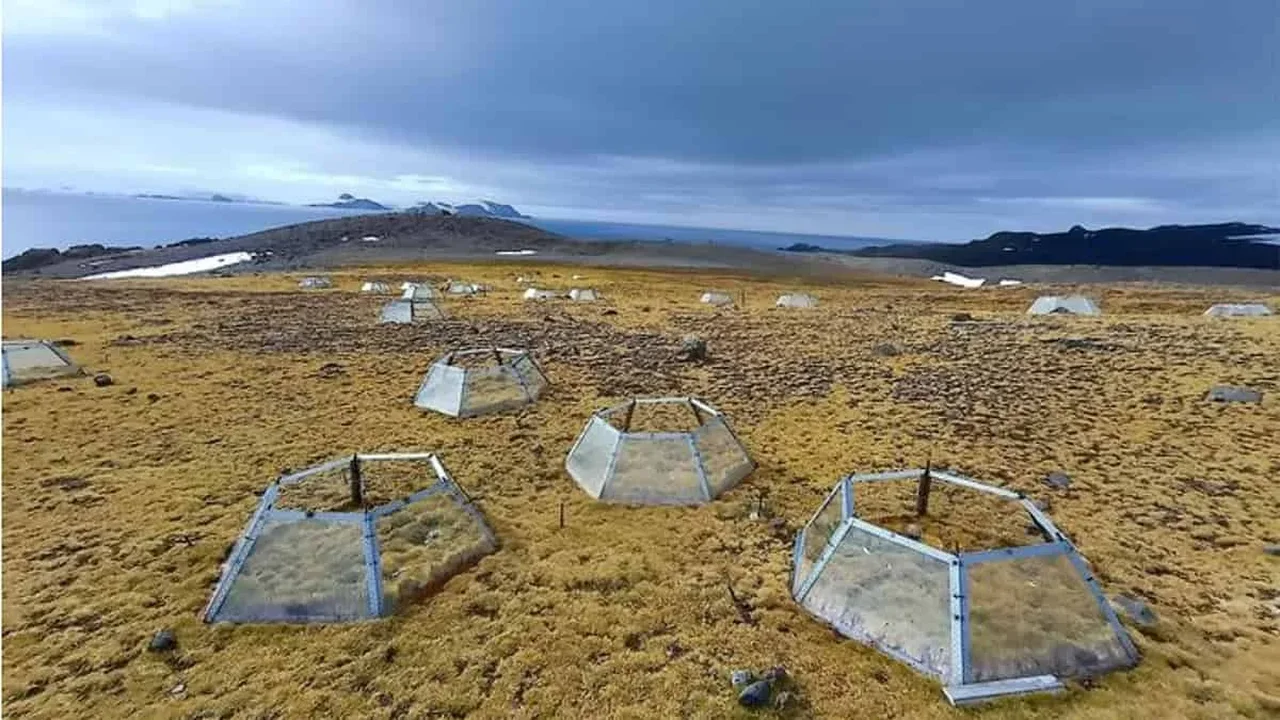
Researchers led by Patricia Sáez of the University of Concepción studied plants grown in open-top chambers designed to raise temperatures. Across the experiment, the chambers warmed average daily air temperatures by about 1.5°C to 3°C. But the conditions also produced sharp temperature fluctuations: during one summer, plants inside the chambers experienced 309 hours below freezing, compared with 32 hours in nearby open plots.
Contrasting responses to changing conditions
After seven years, the hair grass in the chambers moved roughly two-thirds less water through its leaves and photosynthesized about a third less than plants growing outside. Its leaves also developed narrower water-carrying vessels and became thicker.
Pearlwort responded in the opposite direction. Its leaf water movement and photosynthesis each increased by about 44%, while its water-carrying vessels widened. Researchers suggest its compact, cushion-like shape may help buffer it from rapid shifts in conditions, unlike the more exposed grass.
The results suggest that the plants' responses may reflect repeated freeze-thaw cycles as well as warmer average temperatures. The team is continuing to study plants that have spent 16 years in the chambers and is also examining the microorganisms around them.
As Antarctica's climate changes, these contrasting responses could influence which of the two species becomes more prevalent, offering a clearer picture of how local ecosystems may shift.