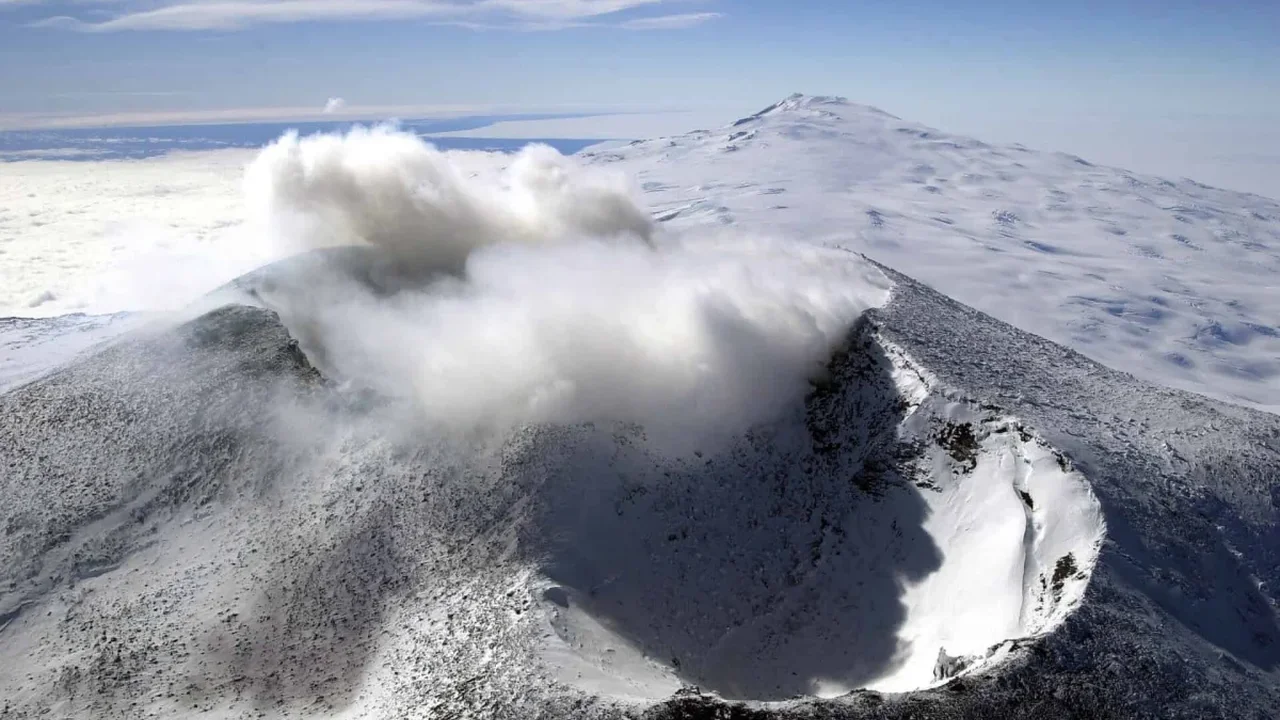
Antarctica's Mount Erebus is more than a dramatic volcanic landmark: it is one of Earth's few volcanoes with a permanent lava lake. Scientists estimate that its plume can carry around 80 grams of microscopic gold each day, a striking detail that has added to the volcano's global fascination.
A rare volcanic system
Rising to 3,794 meters on Ross Island, Mount Erebus is a stratovolcano shaped by layers of lava and volcanic debris. Its most distinctive feature is the long-lasting lava lake in the main crater, sustained by an open magma system that keeps heat and gas circulating.
The volcano's activity is marked by moderate strombolian eruptions, in which gas bubbles burst at the surface and can launch semi-molten material high into the air. Because of its remote Antarctic setting, Erebus poses little risk to cities, yet it remains a valuable natural laboratory for volcanology.
Researchers monitor the mountain through seismic instruments and satellites, including work connected to the Mount Erebus Volcano Observatory. These observations help track thermal changes, gas emissions, and the behavior of its unusual magma.
Why the gold matters
Studies have detected tiny gold particles in Erebus's plume and nearby deposits. The metal likely forms when gold-bearing gases cool and condense into solid particles. The volcano's chlorine-rich chemistry may help transport metals through the system.
Even though the numbers sound impressive, the gold is dispersed across air, snow, and volcanic material, making collection unrealistic. In addition, the Antarctic Treaty's environmental rules protect the continent's mineral resources for science rather than extraction.
Beyond the gold, Erebus offers insight into rare phonolitic lava, volcanic gas dynamics, and even extreme ecosystems shaped by heat beneath the ice. In that sense, the volcano is less a treasure chest than a living archive of planetary processes. Its study may guide future discoveries about Earth's interior and similar environments beyond our planet.