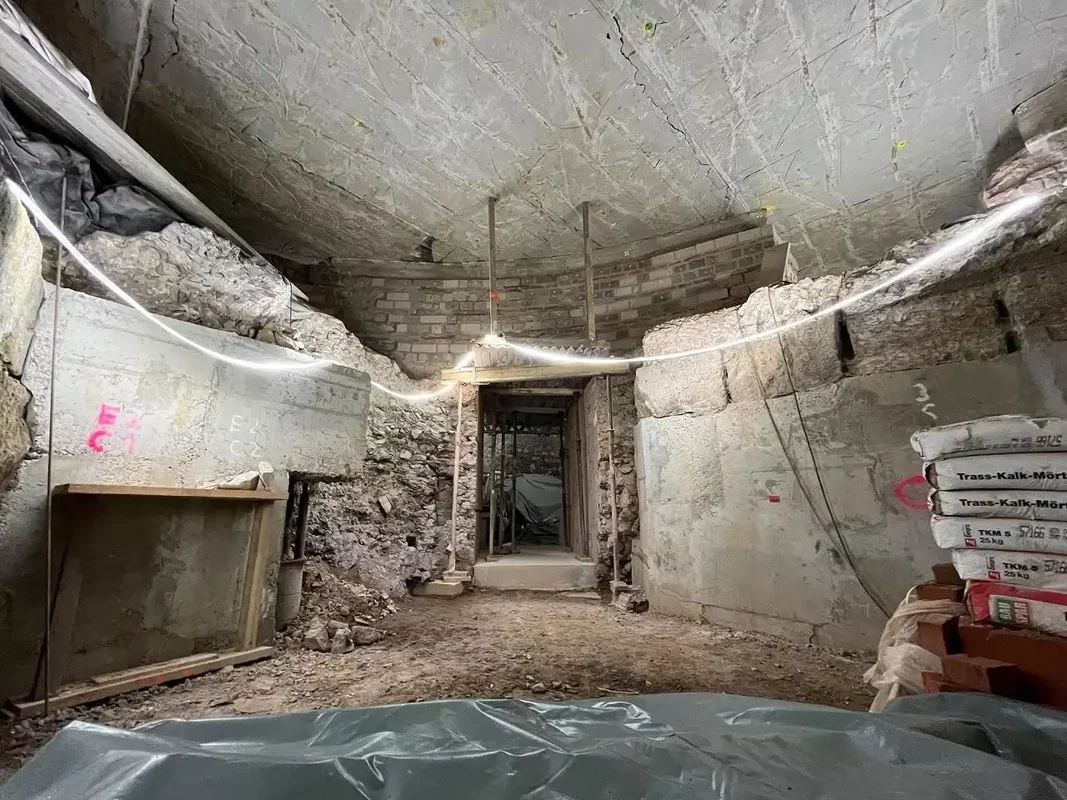
In the heart of Cologne, a city steeped in history, archaeologists have made a remarkable discovery while excavating for the new Jewish Archaeological Museum, known as MiQua. Their efforts have unearthed a significant 4th-century foundation, a stunning 1st-century staircase, and a rare 2nd-century private altar, or lararium, which is the first of its kind found north of the Alps.
This unexpected find lies beneath the modern plaza close to the City Hall, revealing a connection to Cologne's ancient past as Colonia Claudia Ara Agrippinensium, a vital center of the Roman Empire. The staircase, which once led down to the Rhine, served as a vital link between the grand halls of the governor's palace and the bustling lower levels of the city.
Uncovering Hidden Treasures
Cologne's archaeological landscape is often marked by fragments of the past, but the discovery of this nearly 2,000-year-old staircase is a testament to the city's rich heritage. Originally built on a dramatic slope, the staircase was part of a series of terraces designed by Roman architects to manage the elevation down to the river.
Interestingly, medieval builders frequently repurposed Roman staircases for their own constructions, which is likely why this particular staircase has survived the ravages of time. By burying it under layers of earth, the Roman architects effectively protected it from looters in later centuries.
The Surprising Altar
Perhaps the most astonishing aspect of this excavation is the discovery of the lararium. While such altars are commonly found in the well-preserved streets of Pompeii, they are extraordinarily rare in this region. This small shrine would have served as a place for families to honor their household gods, the Lares, through offerings and rituals.
This find offers a unique glimpse into the daily life of a Roman governor, highlighting the continuity of cultural practices even at the edge of the empire. It reveals how the essence of Roman life was maintained far from the Mediterranean heartland.
A Foundation for the Future
In addition to the staircase and altar, archaeologists have also uncovered a massive basilica foundation, constructed with a specialized mortar that has withstood nearly two millennia. The MiQua museum plans to incorporate these ancient structures into its design, allowing visitors to experience the same passages once traversed by Roman elites.
As excavations continue, who knows what other treasures may lie hidden beneath the streets of Cologne?