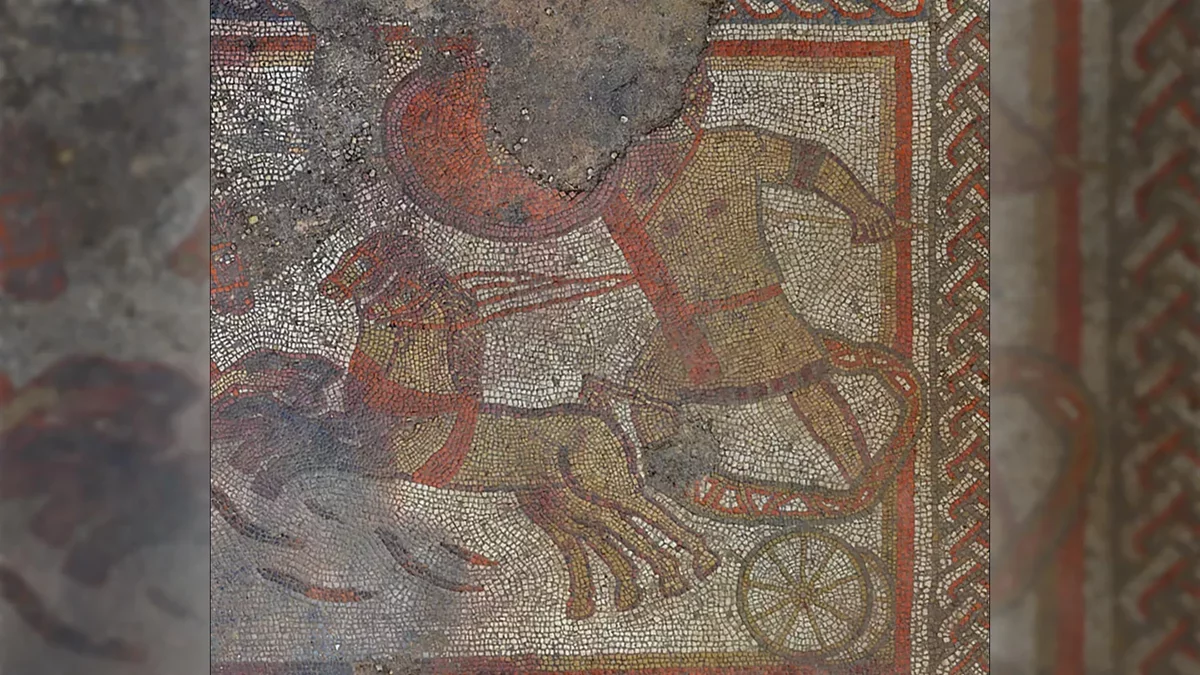
A recent study from the University of Leicester sheds light on the renowned Ketton mosaic in Rutland, which is hailed as one of the most significant Roman discoveries in Britain over the last century. Contrary to initial beliefs that it depicted scenes from Homer's Iliad, this artwork actually presents a unique interpretation of the Trojan War, inspired by the Greek dramatist Aeschylus. This particular version of the tale has unfortunately not survived in its entirety and is considered lost.
The research indicates that the mosaic features decorative elements that have been prevalent throughout the Mediterranean for centuries. This discovery suggests that artists in Roman Britain were intricately linked to the wider artistic traditions of the classical world.
Unveiled During Lockdown
The Ketton mosaic was discovered in 2020 during the COVID-19 lockdown when local resident Jim Irvine noticed it on his family's farm. This find prompted a significant excavation effort by the University of Leicester Archaeological Services (ULAS), backed by Historic England. Due to its national importance, both the mosaic and the adjacent Roman villa have received Scheduled Monument status. Joint excavations by Historic England and ULAS took place in 2021 and 2022, with plans for a comprehensive publication of their findings underway.
The mosaic illustrates three pivotal moments involving the Greek hero Achilles and the Trojan prince Hector: their intense battle, Achilles dragging Hector's lifeless body, and the poignant scene where King Priam negotiates for his son's remains, which are depicted being weighed in gold.
The Trojan War, immortalized in Homer's epic Iliad, narrates a legendary decade-long conflict between Greek forces and Troy, ruled by King Priam. According to myth, the war ignited after Helen of Sparta was taken to Troy.
Aeschylus and a Lost Greek Tragedy
In-depth analysis reveals that the Ketton mosaic does not adhere to Homer's storyline. Instead, it aligns closely with Phrygians, a lesser-known tragedy by Aeschylus. While the Romans were acquainted with various interpretations of the Trojan War, opting for this less conventional version would have distinguished the villa's owner and showcased a level of cultural sophistication.
The study also emphasizes the mosaic's fusion of established artistic motifs from around the Mediterranean.
Dr. Jane Masséglia, the study's lead author and an Associate Professor in Ancient History at the University of Leicester, remarked: "In the Ketton Mosaic, we not only see scenes depicting Aeschylus's version of the story, but the upper panel is inspired by a design found on a Greek pot dating back to Aeschylus's era, 800 years prior to the mosaic's creation. Upon recognizing the use of traditional patterns in one section, I discovered other parts of the mosaic were based on designs visible in much older artifacts, including silverware, coins, and pottery from Greece, Turkey, and Gaul.
"Craftspeople in Roman Britain were not isolated from the ancient world; they were part of a broader network of trade that passed down their design catalogues through generations. At Ketton, we see Roman British craftsmanship intertwined with a Mediterranean design heritage."
Roman Britain and the Broader Ancient Landscape
Jim Irvine, the individual who first uncovered the mosaic, stated: "Jane's thorough research into the Rutland mosaic imagery reveals a remarkable level of cultural integration throughout the Roman world that we are only beginning to grasp. This development suggests that Roman Britain might have been far more cosmopolitan than we typically envision. The new paper presents a captivating and thrilling narrative that deserves recognition."
Rachel Cubitt, Post-Excavation Coordinator at Historic England, added: "Collaborating with the University of Leicester enhances the exploration at the Ketton villa site. This intriguing new research provides a more nuanced understanding of the interests and influences of those who may have resided there, as well as of individuals across Roman Britain during that time."
Hella Eckhardt, a Professor of Roman Archaeology at the University of Reading, who was not involved in the study, commented: "This research is exhilarating, unraveling how the tales of Greek heroes Achilles and Hector were conveyed not only through texts but also through a variety of images crafted by artists using diverse materials, from pottery and silverware to paintings and mosaics."