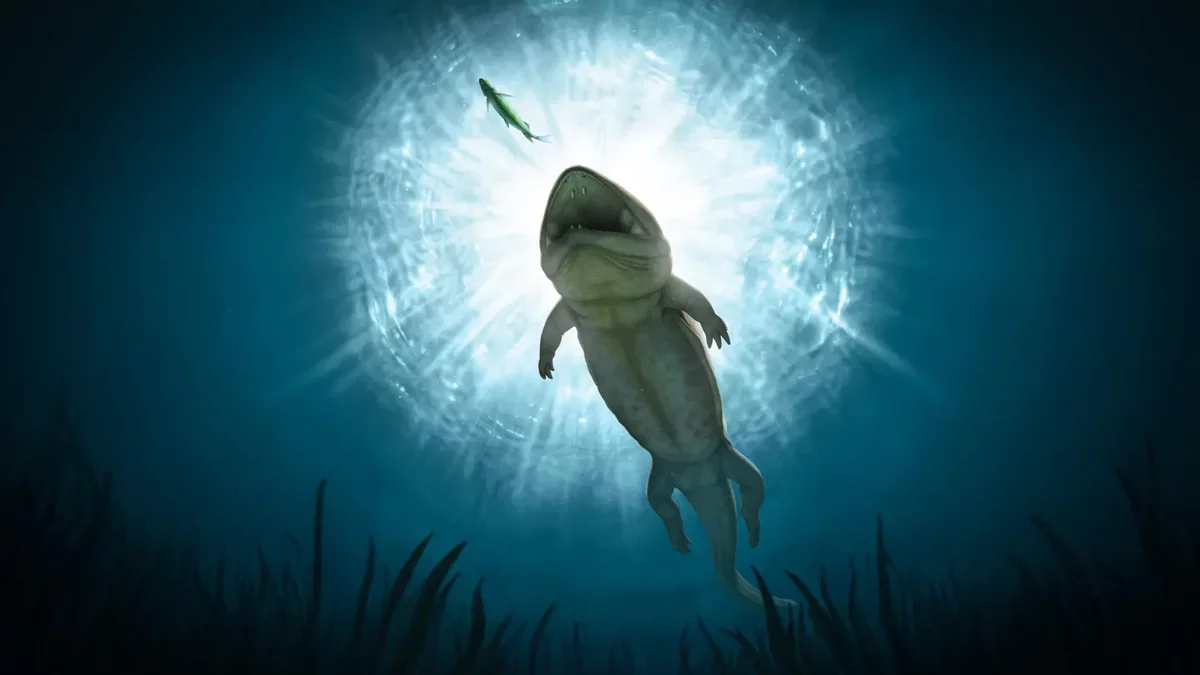
A remarkable discovery has emerged from a garden retaining wall in Australia, where a retired chicken farmer unearthed a stunning fossil while sourcing stones from a local quarry. This significant find has been generously donated to the Australian Museum in Sydney.
Exceptional Preservation of a Rare Fossil
Paleontologist Lachlan Hart, associated with both UNSW Science and the Australian Museum, shares insights about the fossil, now named Arenaerpeton supinatus, which translates to 'supine sand creeper.' This specimen is notably well-preserved, featuring almost the entire skeleton along with faint impressions of the animal's skin.
"This fossil exemplifies a unique group of extinct creatures known as temnospondyls, which thrived before and during the age of dinosaurs," Mr. Hart, a PhD candidate in the School of Biological, Earth and Environmental Sciences (BEES) at UNSW, explains. "Finding skeletons with the head and body intact is rare, and the preservation of soft tissue is even more exceptional."
A Triassic River Predator
Arenaerpeton inhabited freshwater ecosystems in what is now the Sydney Basin during the Triassic period, approximately 240 million years ago. Mr. Hart suggests that this ancient predator likely fed on fish like Cleithrolepis, although little is known about other species that coexisted in its environment.
Visually, Arenaerpeton may evoke comparisons to the modern Chinese Giant Salamander, particularly in its head shape.
"At first glance, Arenaerpeton resembles the modern Chinese Giant Salamander, especially regarding its head structure," Mr. Hart notes. "However, the fossil's rib size and soft tissue outlines indicate that it was significantly bulkier than its contemporary relatives, complete with formidable teeth, including fang-like tusks on its upper jaw."
Size as a Survival Advantage
One striking feature of Arenaerpeton is its impressive size. Mr. Hart estimates it reached about 1.2 meters from head to tail, making it larger than many of its close relatives from the same era. He highlights that later temnospondyls continued to thrive in Australia for an additional 120 million years, with some species growing even larger. This longevity suggests that increased body size may have contributed to their survival through multiple mass extinction events.
A Landmark Discovery for Australian Paleontology
Dr. Matthew McCurry, Senior Lecturer in UNSW's School of BEES and Curator of Palaeontology at the Australian Museum, underscores the significance of this discovery.
"This fossil is among the most important finds in New South Wales over the last three decades, making its formal description particularly thrilling," Dr. McCurry remarks, also a co-author of the study. "It represents a vital piece of Australia's paleontological heritage."
The findings have been documented in the Journal of Vertebrate Paleontology.