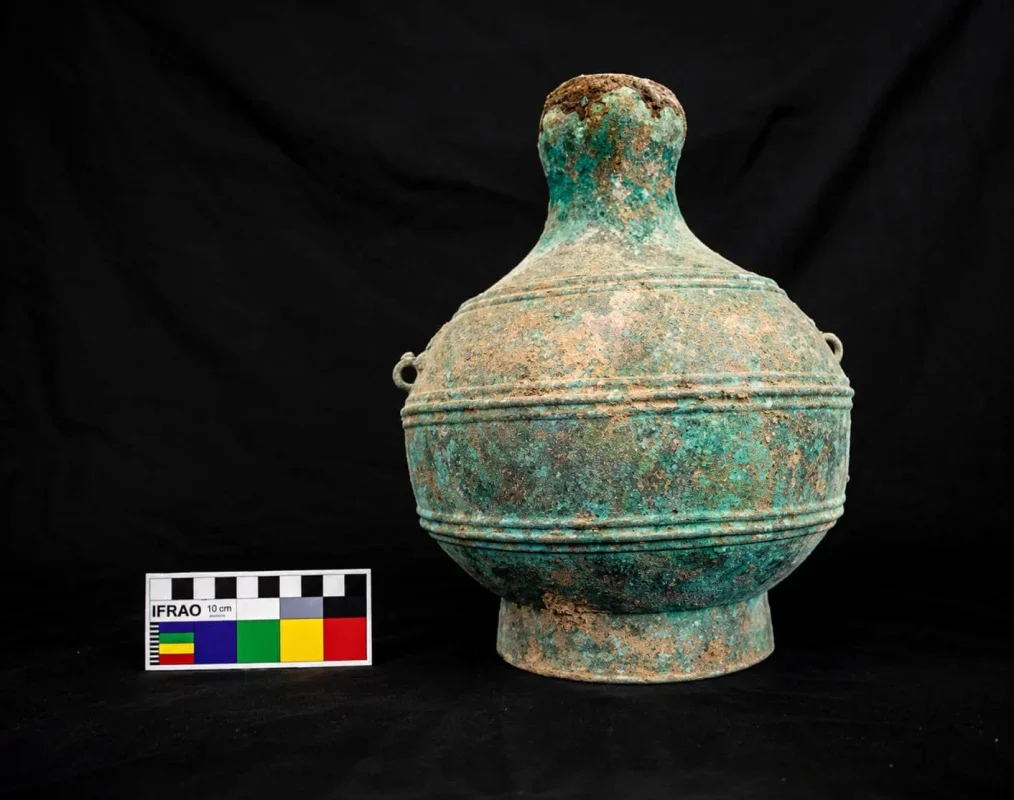
Archaeologists in northwest China have uncovered a remarkable time capsule: a bronze bottle sealed inside a tomb in Ningxia that still contained liquid after more than 2,000 years. The vessel was found in tomb M39 at the Shanjiabao cemetery, where researchers examined a burial landscape linked to the Qin state.
The bottle held about 3.7 liters of pale blue-green liquid. Chemical analysis showed that it was not water and was unlikely to be fruit wine. Instead, the evidence points to a fermented grain drink made mainly from broomcorn millet, with smaller amounts of wheat or barley.
What the analysis revealed
Researchers used spectroscopy and mass spectrometry to study the preserved liquid and the sediment at the bottom of the vessel. The results showed high levels of lactic acid and oxalic acid, along with many organic compounds such as amino acids, sugars, and fatty acids. That profile fits an ancient alcoholic beverage rather than groundwater that entered the bottle later.
The sediment offered even more detail. Microscopic study identified more than 100,000 starch grains, with millet making up the vast majority. The team also found thousands of yeast cells, a strong sign that fermentation had taken place. Damage on some wheat and barley starches suggests the grains were processed before brewing.
These clues point to the use of qu, a traditional Chinese fermentation starter made from mold-inoculated grains. In ancient brewing, qu helped convert starches into sugars and supported the microbes that produced alcohol. The vessel's tight seal, likely created with textile and daub, helped preserve the contents for millennia.
The find also adds to the history of Chinese brewing. Earlier evidence shows alcohol production in China dating back roughly 9,000 to 10,000 years, with northern regions often favoring millet-based drinks. This Qin-era example shows a refined recipe that blended local grains with an established fermentation method.
Although the liquid is no longer safe to drink, the discovery offers a vivid look at ancient food science, craftsmanship, and daily life on the Qin frontier. It shows how early communities turned local crops into a sophisticated beverage tradition that was already well developed before the rise of imperial China. This kind of discovery may help future researchers reconstruct the origins of brewing with greater precision.