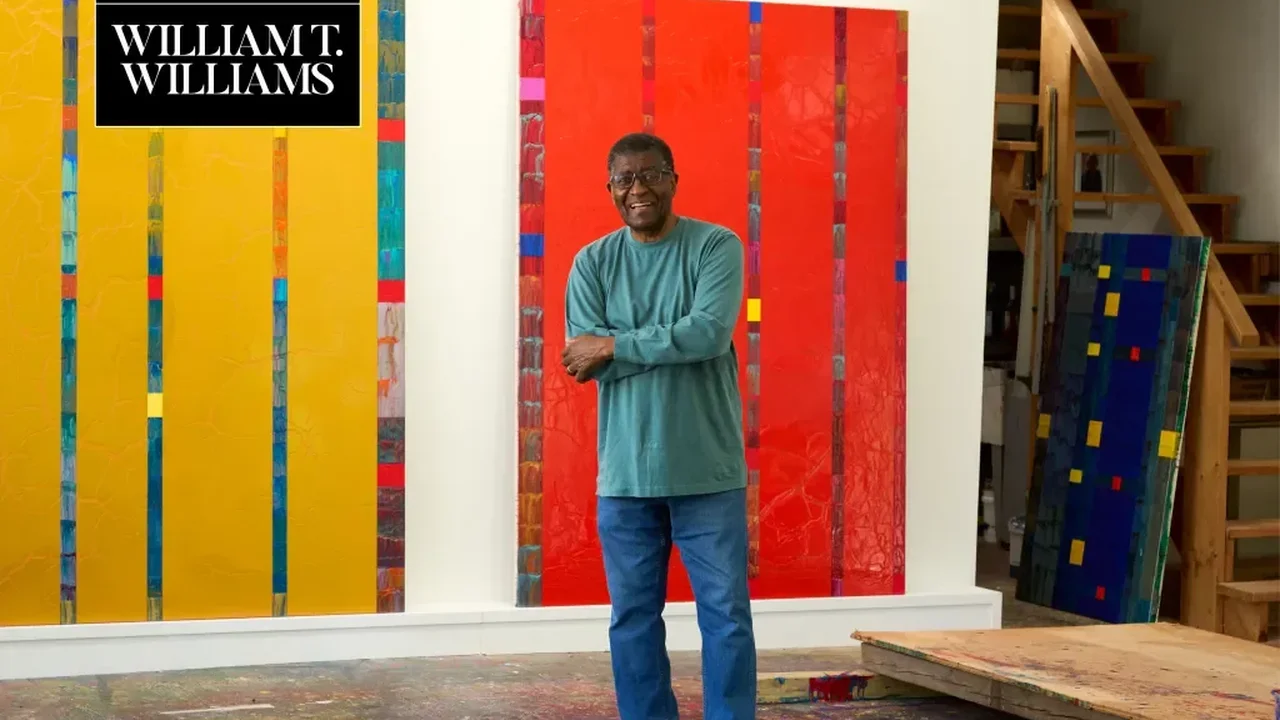
For more than six decades, William T. Williams has approached painting as a space for continual discovery. The American artist's evolving abstract canvases are shaped by geometry, layered color and a practice that balances careful planning with openness to surprise.
Working between Connecticut and New York, Williams has found fresh inspiration in the changing qualities of studio light. Natural illumination, he says, has influenced the structure of his newer paintings, encouraging more vertical compositions and creating new relationships between canvas, color and space.
Painting as an evolving system
Williams builds his works gradually, applying thin layers of paint over months and sometimes years. Deliberate gaps between layers produce the cracked surfaces that have become a defining feature of his recent work. These openings reveal the painting's construction and turn texture into an active part of the composition.
Small studies play a central role in his process. They allow Williams to test arrangements, color relationships and visual rhythm before ideas expand onto larger canvases. Blue tape and paper markers often help map a composition, while subtle adjustments in paint mixtures alter drying time, sheen and density.
His latest paintings explore figure and ground, inviting viewers to question whether blocks of color sit on a surface, recede behind it or create openings within it. This investigation connects with his celebrated late-1960s Diamond in a Box works, where geometric forms overlap and redirect the eye across the canvas.
A legacy beyond the canvas
Born in North Carolina in 1942 and raised in New York, Williams studied at Pratt Institute and later at Yale. Alongside a sustained studio practice, he taught for nearly four decades at Brooklyn College, encouraging students to see materials as collaborators in the creative process.
Williams also helped imagine an artist-residency model that was implemented by the Studio Museum in Harlem in 1969. The program provided artists with studio space, professional networks and opportunities to develop ambitious practices. His community-focused work with Smokehouse Associates further demonstrated how abstract art could activate public spaces through participation and dialogue.
For Williams, abstraction does not require specialist knowledge; it asks for attention and presence. His work continues to show how experimentation, mentorship and material curiosity can keep artistic language vital across generations. His approach may inspire future artists to treat painting not as a fixed tradition, but as an endlessly adaptable field of discovery.