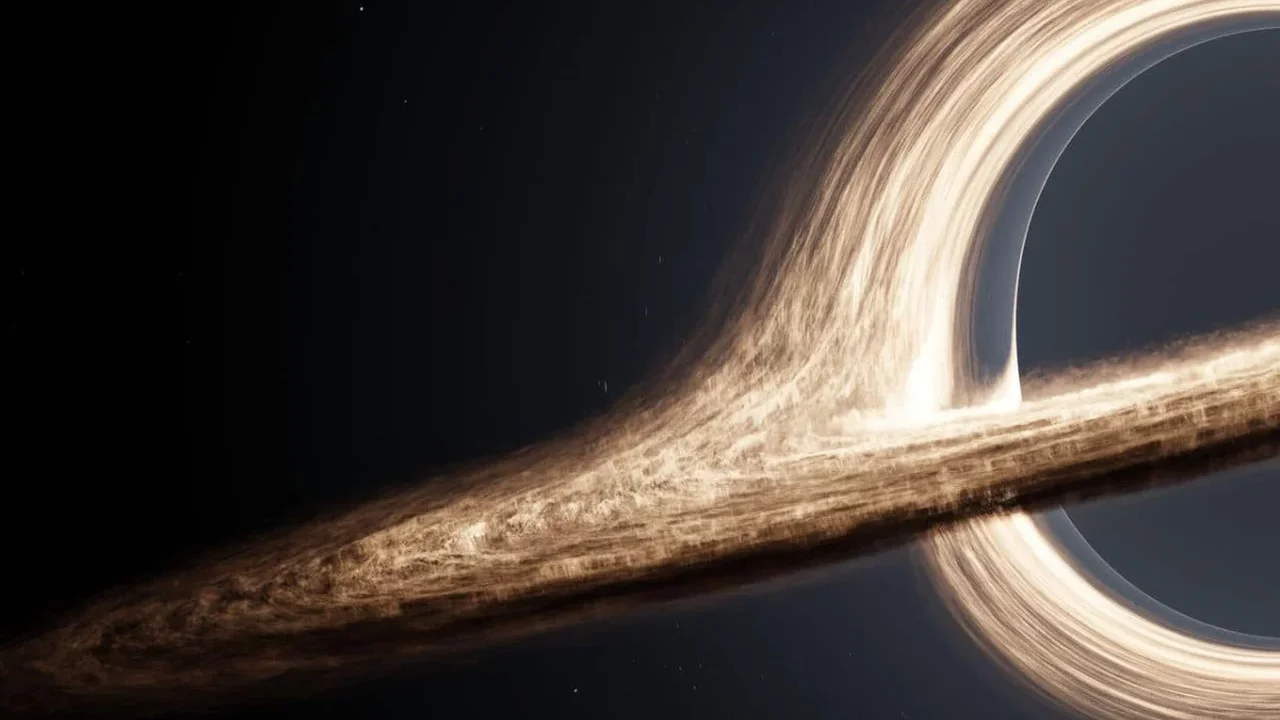
Most large galaxies are believed to host a supermassive black hole at their core. Yet some black holes may spend billions of years orbiting far from the galactic center, preserving traces of the mergers and gravitational encounters that shaped their host systems.
Researchers from Yale University and the University of North Texas explored this possibility using the ASTRID cosmological simulation, which follows the evolution of galaxies and black holes across roughly 12.6 billion years.
Black holes beyond galactic centers
When galaxies merge, their central black holes do not always quickly settle into one shared nucleus. In some cases, one black hole remains on a distant orbit within the newly combined galaxy. These objects are known as wandering black holes: they are still associated with a galaxy, but are located well away from its center.
The simulation suggests that this effect may be especially significant in lower-mass galaxies. Over time, some smaller galaxies become less likely to retain a black hole at their center and more likely to host one farther out. This means galaxies thought to be missing central black holes could still contain them in less expected regions.
Signals from the early universe
The distribution of wandering black holes may also help astronomers investigate how the first massive black holes formed. One leading model proposes that they began as relatively small remnants of the first stars. Another suggests that enormous primordial gas clouds collapsed directly into much larger black hole seeds.
In massive galaxies, repeated mergers can erase much of this early history. Smaller galaxies, however, may preserve a clearer record. The ASTRID results indicate that the number and location of black holes in these systems could reveal whether their earliest seeds were relatively light or already exceptionally massive.
Detecting these elusive objects remains challenging because inactive black holes emit little light. Future searches may combine deep X-ray, radio, infrared and spectroscopic observations beyond galactic nuclei to identify their presence. The research was published in The Astrophysical Journal Letters.
As observational tools become more sensitive, wandering black holes could transform overlooked corners of galaxies into a new archive of the universe's earliest growth.