Recent research indicates that a global marine heatwave has led to extensive coral bleaching, impacting approximately half of the world's coral reefs. This study, spearheaded by scientists from the Smithsonian, represents the first comprehensive analysis of coral bleaching on a global scale during such an event. A new heatwave that commenced in 2023 is still ongoing. The findings are published in Nature Communications.
Understanding Coral Bleaching
Corals thrive through a symbiotic relationship with two organisms: a small animal related to jellyfish that forms the hard structure of the reef, and microscopic algae that reside within the coral tissues, using sunlight to generate energy for the coral.
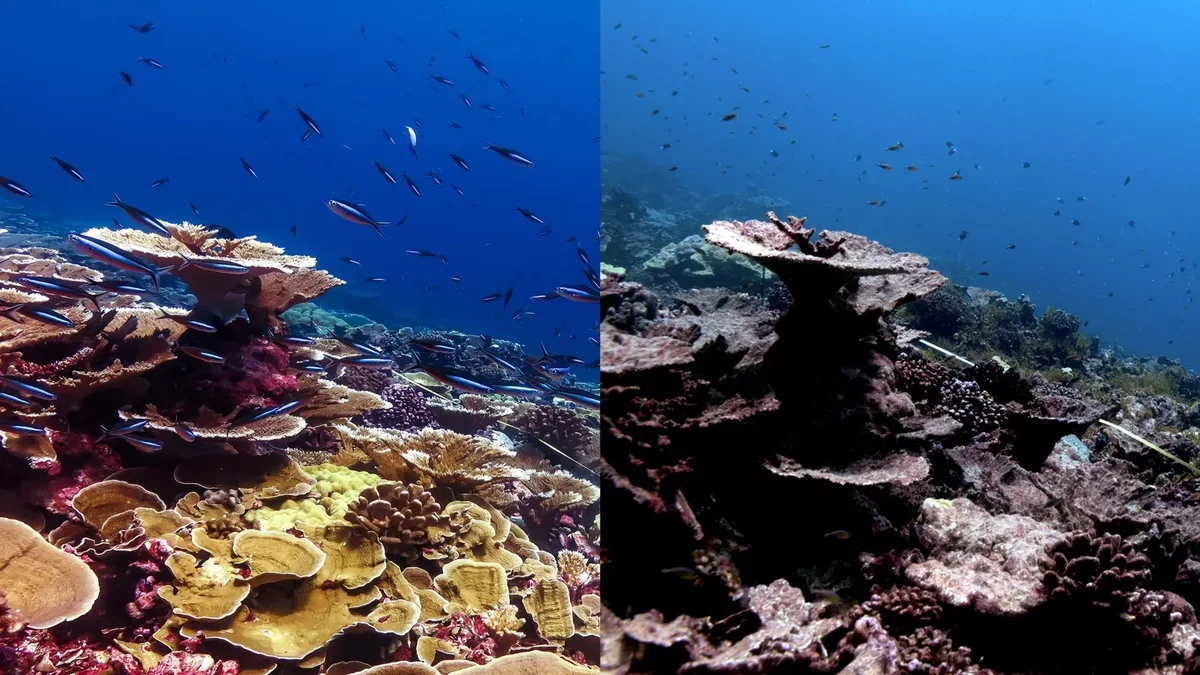
When ocean temperatures escalate beyond a certain threshold, this delicate partnership deteriorates. The coral expels the algae, resulting in a white appearance known as bleaching. Without these algae, corals experience slower growth, reduced reproduction rates, and can face mortality if the heat stress is prolonged or severe.
Assessing the Third Global Coral Bleaching Event (2014-2017)
To gauge the extent of damage during the "Third Global Coral Bleaching Event" (2014-2017), an international team of scientists collaborated. The initiative was led by researchers from the Smithsonian Tropical Research Institute (STRI), James Cook University in Australia, and the former director of Coral Reef Watch at the U.S. National Oceanic and Atmospheric Administration (NOAA).
The team integrated satellite data on ocean surface temperatures from the Coral Reef Watch system with on-site reef assessments and aerial observations gathered globally. This methodology enabled them to correlate heat exposure from space with actual reef conditions.
"This analysis is the most geographically extensive examination of coral bleaching ever conducted," remarked Sean Connolly, a senior scientist at the Smithsonian. "Nearly 200 co-authors from 143 institutions across 41 countries contributed valuable data."
Widespread Coral Damage and Mortality
The researchers evaluated over 15,000 reef surveys, discovering that 80% of reefs experienced moderate or worse bleaching, with 35% showing moderate or higher levels of coral mortality.
By establishing the relationship between heat stress and reef damage at surveyed locations, the team utilized satellite-based heat data to estimate impacts on reefs that were not directly analyzed. Their estimates indicate that more than 50% of coral reefs globally faced significant bleaching, with 15% experiencing considerable mortality.
As coral reefs decline, the essential services they provide, such as tourism and seafood supplies for millions, are also at risk.
"The levels of heat stress were unprecedented during this event, prompting Coral Reef Watch to establish new, elevated bleaching alert levels not required in previous events," explained C. Mark Eakin, the study's lead author and former director of Coral Reef Watch.
"Approximately half of the reef locations subjected to bleaching-level heat stress encountered these conditions multiple times during the three-year event, often with catastrophic results," added Scott Heron, a physics professor at James Cook University. "This included consecutive bleaching events on Australia's Great Barrier Reef, which has experienced three additional bleaching incidents since then. Reefs are unable to recover adequately before the next bleaching event strikes."
Ocean Warming and the Fourth Global Bleaching Event
In the last thirty years, the planet has witnessed a loss of about 50% of its coral. The oceans absorb a significant portion of the excess heat produced by burning fossil fuels. Without this absorption, global air temperatures could soar to around 50 degrees Celsius (122 degrees Fahrenheit).
Data collected globally now confirms that Earth is currently undergoing a Fourth Global Coral Bleaching Event.
"Our findings reveal that the Third Global Coral Bleaching Event was the most extensive and severe coral bleaching event documented," Connolly stated. "Yet, reefs are now facing an even more intense Fourth Event, which began in early 2023."
The Importance of Global Coral Reef Monitoring
"Local, regional, and global economies are heavily dependent on the health of natural systems like coral reefs, which we often overlook," noted Joshua Tewksbury, director of STRI. "It is crucial for scientific communities to unite, as this global team has, to monitor how these vital systems are changing. Achieving this effectively and at scale requires connecting different geographies and integrating technologies -- from Earth observation satellites to in-water surveys that calibrate observations from space and reveal the extent of the damage."