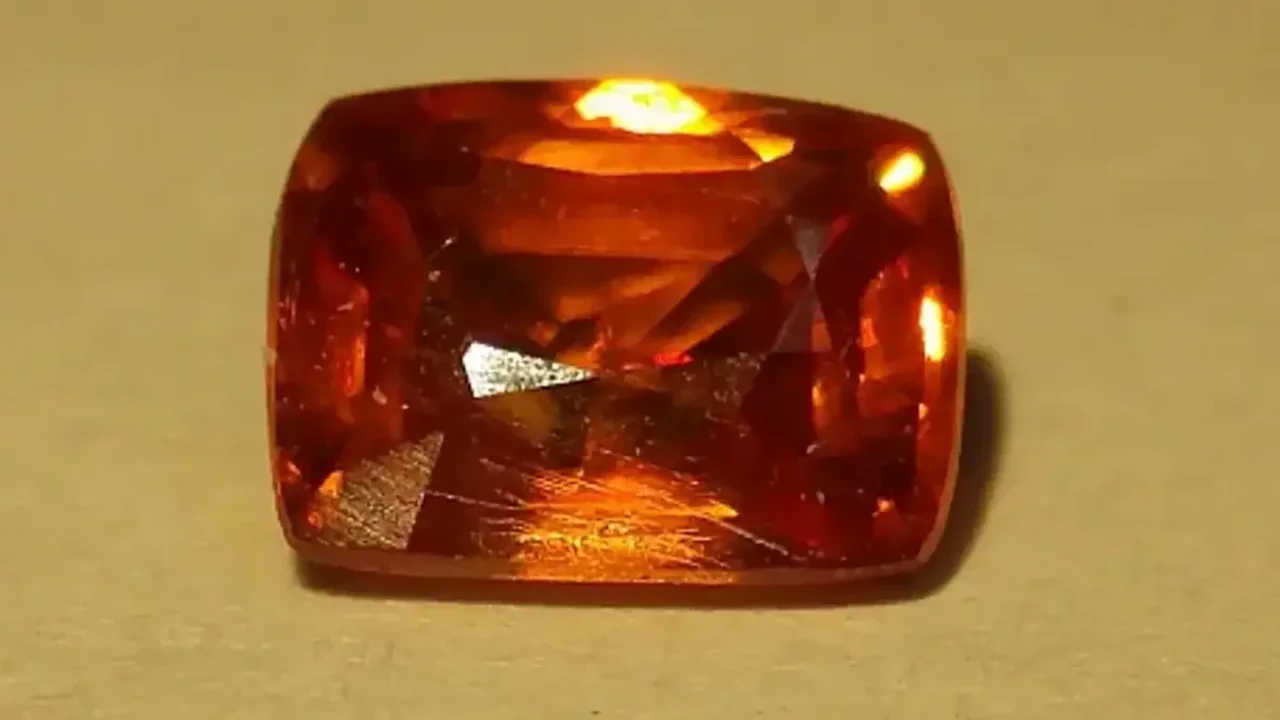
A tiny orange crystal from Myanmar has become one of geology's most fascinating mysteries. Named kyawthuite, the mineral is known from just one scientifically documented natural specimen, making it a true outlier in the mineral world.
The only sample found so far weighs 1.61 carats, or about 0.32 grams, and is preserved at the Natural History Museum of Los Angeles County as the reference specimen for the species. It was discovered in 2010 in the Chaung Gyi Valley near Mogok by Burmese mineralogist and gemologist Dr. Kyaw Thu, whose name inspired the mineral's title.
What Makes It So Unusual?
Kyawthuite is a bismuth-antimony oxide with the formula Bi₃⁺Sb₅⁺O₄, plus traces of tantalum. What sets it apart is not the rarity of its ingredients, but the exact way they are arranged in nature. Its crystal structure is highly distinctive, with dense layers of antimony and oxygen paired with bismuth atoms. The mineral is also remarkably heavy for its size, with a density about eight times that of water.
Researchers believe it likely formed in pegmatite, a rock type created during the final stages of magma cooling. Myanmar's geology, shaped by powerful tectonic forces over millions of years, has produced an unusual concentration of gemstones and rare minerals, including ruby, sapphire, spinel, tourmaline, peridot and painite.
A Geological One-Off
The International Mineralogical Association officially recognized kyawthuite as a new mineral in 2015. Since then, no second specimen has been confirmed. That makes the single crystal in Los Angeles not only a scientific reference point, but also a reminder of how much of Earth's mineral diversity may still be undiscovered.
For scientists, kyawthuite highlights the hidden complexity of planetary chemistry and the value of careful mineral research. Its story suggests that future discoveries may still emerge from the most unexpected places, reshaping how we understand Earth's rarest materials.