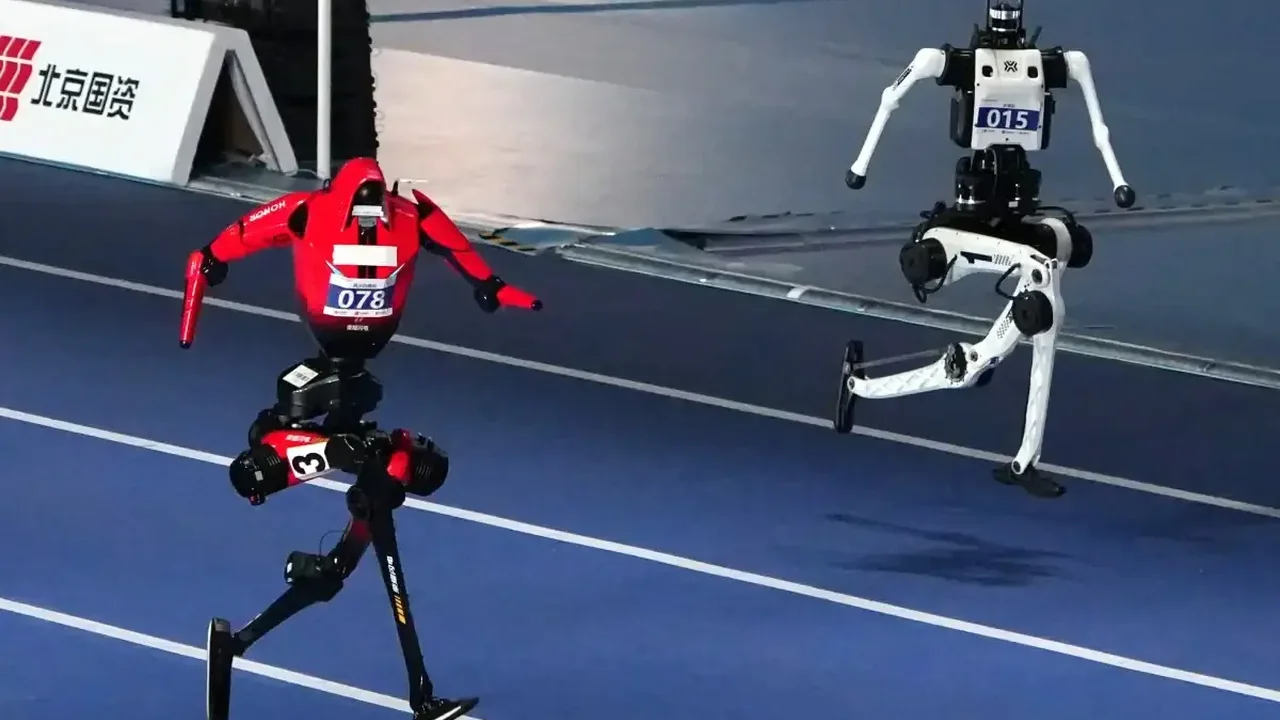
At the World Humanoid Robot Games in Beijing, a Chinese humanoid robot named Tiangong Ultra completed the 100-meter race in 8.86 seconds, a pace that surpassed Usain Bolt's human world record. The run was a striking demonstration of how quickly robotics is advancing, even though the machine then failed to stop cleanly and collided with a safety barrier.
The event highlighted both progress and precision challenges in humanoid engineering. In another semifinal, a competing robot also lost stability during the race. Still, the overall performance marked a major leap from last year, when Tiangong Ultra needed 21.50 seconds to win the same distance.
Rapid Progress in Humanoid Motion
This year's competition brought together more than 2,000 robots from 666 teams across 51 events, ranging from sprinting and high jump to practical tasks such as firefighting, laundry folding, and package handling. According to the Beijing Humanoid Robot Innovation Center, robots also posted notable results in other athletic tests, including a 2.88-meter high jump and a 38.15-second 400 meters.
Researchers say the most important takeaway is not only speed, but coordination. Running on two legs requires full-body balance, joint control, and constant adjustment. Some robots even used unconventional movement patterns discovered through simulation-based reinforcement learning, showing that humanoid design is evolving beyond simple imitation of human motion.
From Showcase to Real-World Use
Beyond the spectacle, the games also tested practical skills for future workplaces and homes. Robots were asked to wash clothes, organize shelves, move luggage, and respond to changing tasks in factory-like environments. In one firefighting challenge, only a small number of teams completed the full sequence, underscoring how demanding real-world autonomy remains.
Industry interest is growing alongside the technical progress. China has identified humanoid robotics as a strategic emerging sector, while companies worldwide are exploring factory and service applications. The latest results suggest that the next breakthrough may not be another fast sprint, but a robot that can work reliably, adapt smoothly, and complete everyday tasks with consistency. That shift could redefine how humans and machines share future spaces.