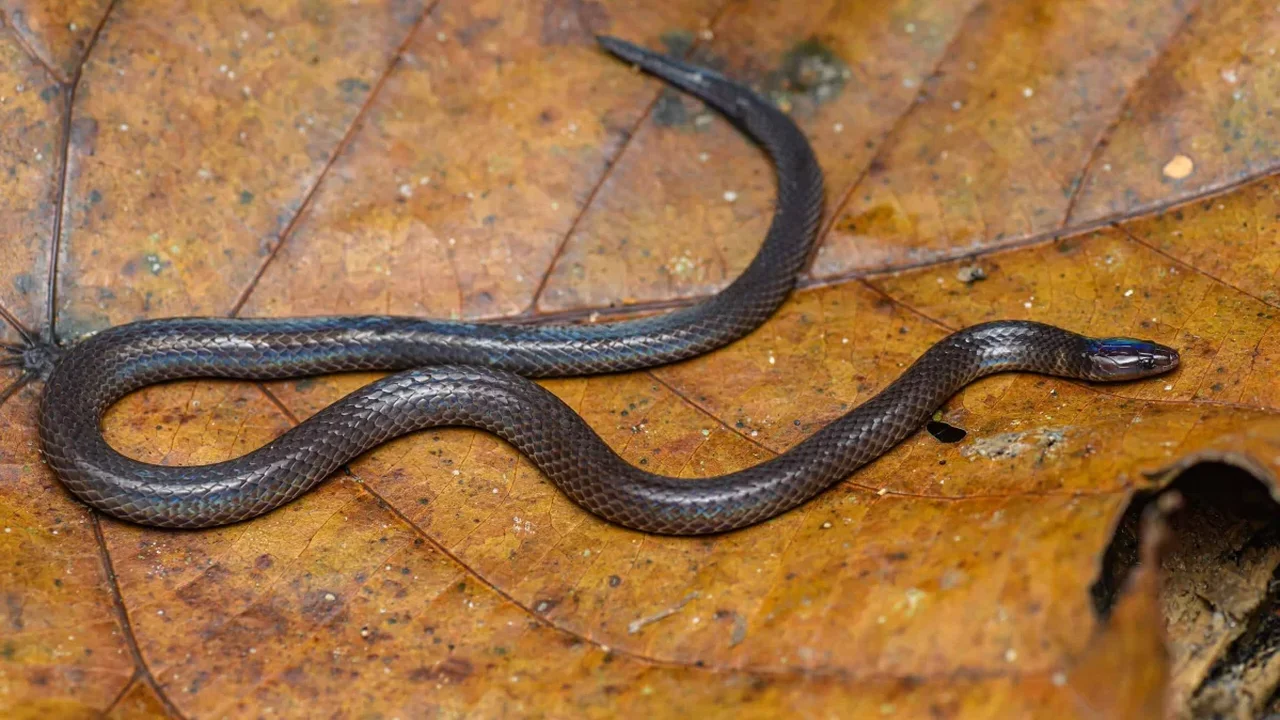
When danger approaches, dwarf reed snakes have an unusual escape move: they launch into a rapid series of body rolls, moving far faster than they do when slithering.
A study published in Current Biology examined the behavior in 13 snakes from three species. The researchers, led by Yosuke Kojima of Toho University, found that the animals could roll at peak speeds of up to 3.69 meters per second--about 13 kilometers per hour and roughly four times their peak slithering speed in the experiments.
A rolling escape, with the head held steady
The snakes form a tight curve, push off the ground with the tail, then swing an arch of their body over and past the head. Alternating this movement from side to side creates a chain of cartwheels.
Although much of the body rotates, the head stays relatively steady and pointed forward. This coordination may help the snake maintain its orientation as it moves. The team recorded the behavior in laboratory tests and also observed rolling in natural surroundings. In the lab, the snakes were able to travel along a narrow track without simply tumbling away.
The findings do not yet show whether the snakes can deliberately steer once rolling, or how well the technique works across the uneven, cluttered ground of a forest. The researchers also do not know whether the behavior depends on specialized anatomy, neural control, body mechanics, or a combination of factors. Related snakes tested for comparison did not roll, but the small sample cannot establish whether the ability is absent from other species.
By rotating their bodies while keeping their heads comparatively stable, dwarf reed snakes achieve a wheel-like motion without an actual wheel or axle. Further study of this rare behavior could reveal new details about animal movement and inspire fresh approaches to flexible robotics.