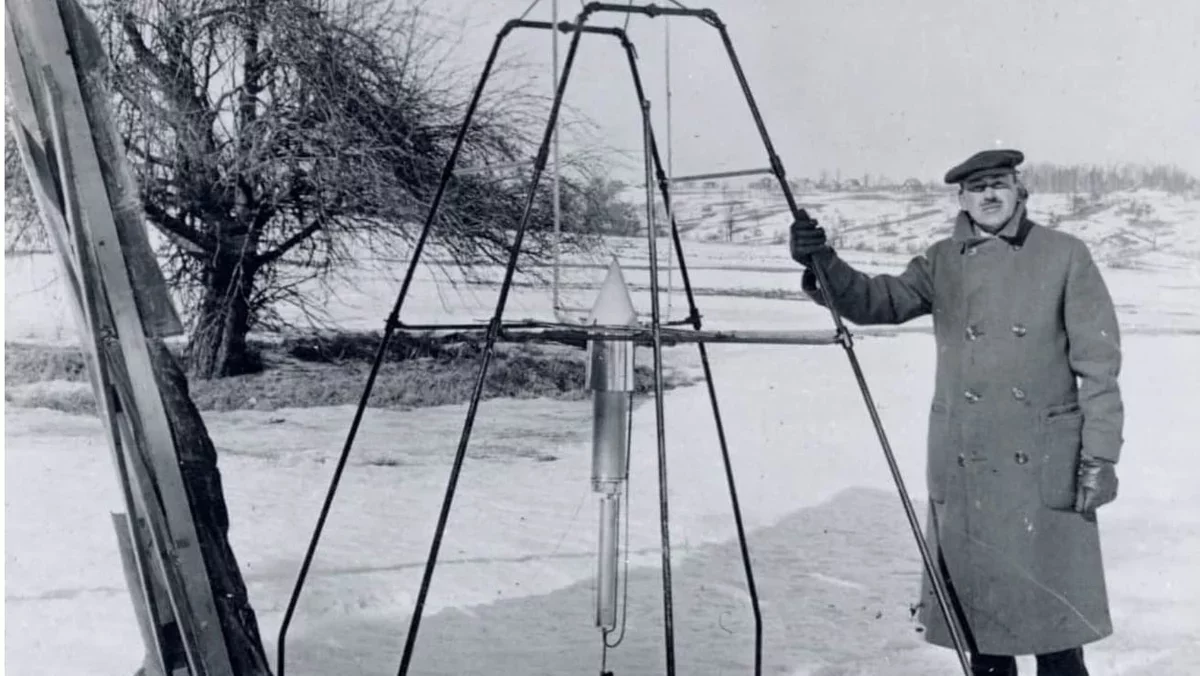
One hundred years ago, on a snowy farm in Auburn, Massachusetts, Robert Goddard stood next to an unassuming machine that would change the course of history. This narrow, awkward rocket, measuring about 11 feet in height and weighing around 10 pounds, made its inaugural flight on March 16, 1926. In just under three seconds, it ascended 41 feet and traveled approximately 60 yards before landing back in a cabbage patch. Although modest in scale, this moment is celebrated by NASA as the first successful launch of a liquid-fueled rocket, marking a pivotal point in the evolution of space exploration.
At the time, many dismissed Goddard's ambitions as unrealistic. His groundbreaking work, however, laid the foundation for the exploration of space. Despite skepticism, he pressed on, undeterred by the ridicule that accompanied his vision. His journal entry following the launch described the rocket, named Nell, as "almost magical" in its ascent, a sentiment that resonates with the awe experienced during contemporary launches, such as the recent Artemis II mission.
Pioneering Contributions to Spaceflight
Goddard's innovations in rocketry encompassed vital concepts that are now standard in modern spaceflight, including guidance systems, power-driven fuel pumps, and steerable thrust. The journey from Goddard's cabbage patch to the monumental rockets of the space age was not instantaneous; it was a gradual process marked by experimentation, setbacks, and relentless perseverance.
The advancements in rocketry gained significant momentum during World War II, which, while morally complex, accelerated technological progress. The V-2 missile, developed in Nazi Germany, was a landmark achievement, being the first large-scale liquid-fueled rocket and long-range guided ballistic missile. This dual nature of rocketry--serving both scientific and military purposes--has persisted throughout its history.
The launch of Sputnik in 1957 marked a transformative moment in global perception of space. This small satellite initiated the space age, reshaping national priorities and driving the establishment of NASA in 1958. Space exploration became a focal point for scientific advancement and international competition.
As the decades progressed, NASA's ambitions expanded. The Apollo 4 mission in 1967 showcased the Saturn V rocket, a behemoth standing at 363 feet tall, capable of carrying humans to the Moon. This journey culminated in the historic Apollo 11 mission, which remains a defining moment in human history.
Looking to the Future
Today, NASA is once again aiming for the Moon with Artemis II, which signifies not just a return but a new era of human exploration beyond Earth. The Space Launch System that carried Artemis II is a staggering 30 times taller and half a million times heavier than Goddard's initial rocket, illustrating the remarkable progress made in the field.
As we look forward, NASA is exploring innovative propulsion methods, including nuclear thermal and electric systems, which promise to enhance the efficiency of future space missions. The story of rocketry is a testament to human innovation and resilience, illustrating that even the most ambitious ideas can emerge from the most humble beginnings.
Ultimately, the legacy of Goddard's cabbage patch serves as a powerful reminder that history often starts in unexpected places, driven by the relentless pursuit of knowledge and exploration.