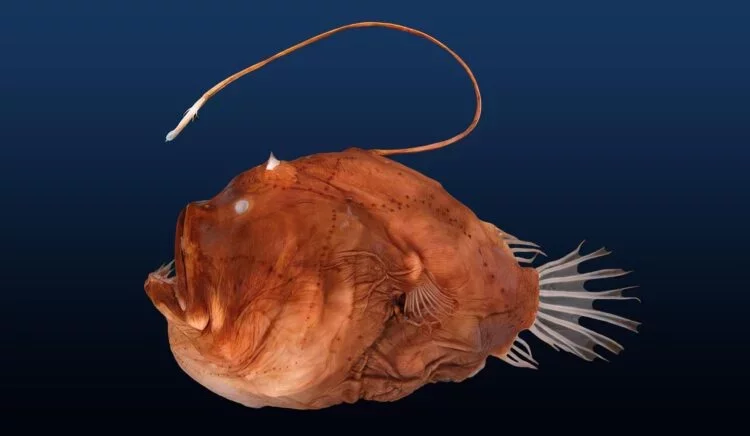
The anglerfish, known for its bizarre appearance and unique hunting techniques, has intrigued scientists with its evolutionary journey. A recent study sheds light on how these fascinating creatures transformed their fins into sophisticated fishing tools over millions of years.
Anglerfishes are often perceived as grotesque, particularly with their signature bioluminescent lure dangling from a wide mouth filled with sharp teeth. However, the evolutionary story behind these adaptations is both intricate and remarkable. Researchers Alex J. Maile and Matthew P. Davis conducted a comprehensive analysis of a fossil-calibrated family tree, examining 118 specimens across 102 species, revealing a diverse lineage.
Diverse Origins in the Late Cretaceous
Imagine being a small fish in the Late Cretaceous period, unaware that dinosaurs were on the brink of extinction. Survival meant navigating a world where it was eat or be eaten. The transformation from ordinary fish to the extraordinary anglerfish is a tale of gradual adaptation. The study indicates that the earliest anglerfish ancestors thrived in shallow waters, where their dorsal fins began evolving into a unique structure known as an illicium.
This adaptation likely served multiple purposes, not just attracting prey but also aiding in mate selection, particularly in the deep sea where visibility is limited. As Maile notes, anglerfishes exhibit a remarkable variety, with species found in diverse habitats such as coral reefs and deep-sea environments.
Specialized Lures and Evolutionary Success
Different anglerfish species have developed varied lures suited to their hunting strategies. For instance, frogfishes position their lures to optimize prey capture, while batfishes aim theirs at the seafloor. This evolutionary process demonstrates that nature often opts for practical solutions, combining effectiveness with simplicity.
Interestingly, some anglerfish have also evolved chemical lures, releasing scents to attract prey--a development that occurred independently in different lineages. This adaptation allows them to target prey that rely on chemical cues rather than visual ones, enhancing their hunting capabilities.
Illumination in the Deep
The research highlights that anglerfish with advanced lure structures tend to diversify more successfully. Those that developed bioluminescence not only improved their chances of capturing prey but also played a crucial role in mating strategies. Female anglerfish often possess elaborate lures, while males have adapted sensory systems to detect these signals, showcasing a dual-purpose evolution.
Despite the challenges of studying these elusive creatures in their deep-sea habitats, this research marks a significant advancement in our understanding of anglerfish evolution. The findings suggest that around 70 million years ago, a fish began utilizing a modified spine for hunting, leading to the intricate chemical and light-based lures we observe today.
This study, published in BioOne, not only enriches our knowledge of anglerfish but also emphasizes the incredible adaptability of life in the ocean. As we continue to explore these depths, the potential for discovering further evolutionary marvels remains vast.