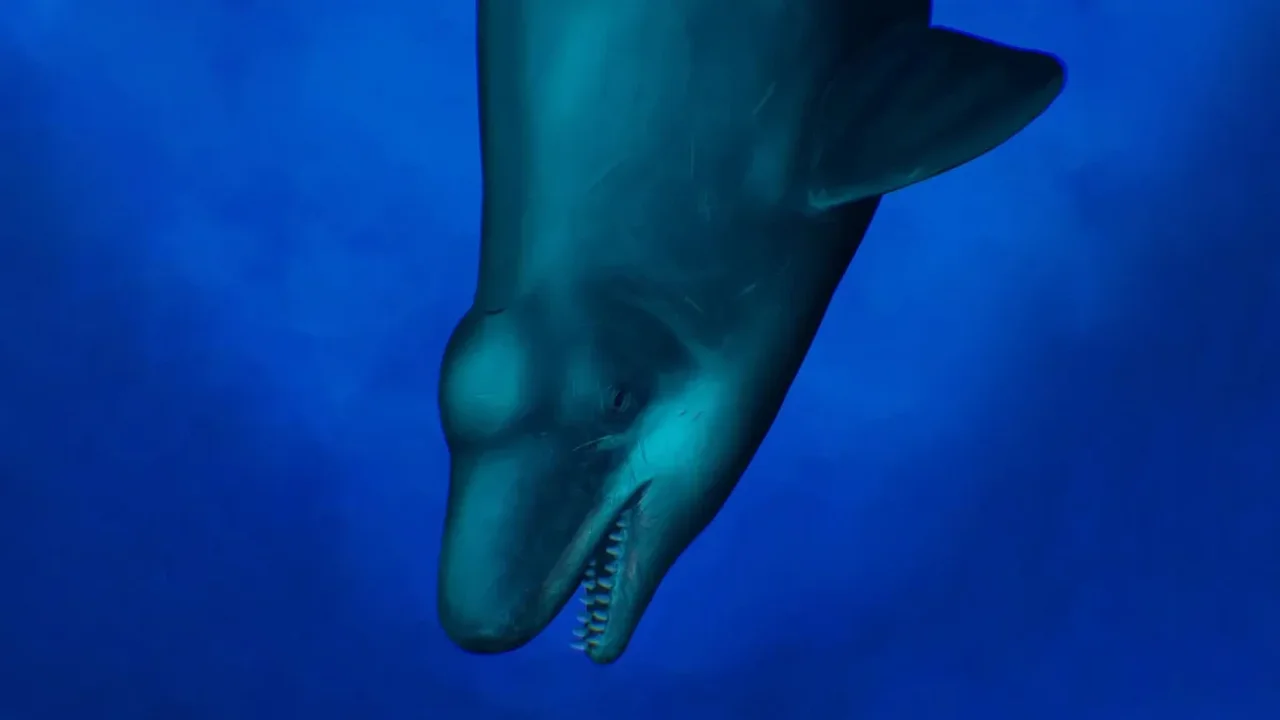
Around six million years ago, a small whale off the coast of what is now Peru may have searched the seabed for food using echolocation and suction. Its unusually angled snout and highly asymmetrical skull set it apart from other known toothed whales.
Named Scaphokogia huachafo, the extinct pygmy sperm whale measured about 2.7 metres long. Its fossil skull was discovered in Peru's Pisco Formation in the 1990s, but researchers later determined that its dramatic lopsidedness was part of its natural anatomy--not damage caused after burial.
A distinctive head and hunting posture
To assess the skull's shape, researchers created 3D models and compared it with those of 30 living and extinct toothed whales. The analysis placed S. huachafo among the most asymmetrical cetaceans known. Its nostrils were positioned on the left side, while its heavy snout sloped sharply downward.
The team suggests that the reinforced snout may have shifted the whale's centre of gravity forward, helping it keep its head angled toward the seabed. That anatomy could have enabled it to cruise over soft sediment, use sound to locate prey, then draw food into its mouth through suction--rather like an underwater vacuum cleaner.
Evidence from the skull also suggests the whale may have lost its upper teeth as it matured. However, the soft tissues involved in producing and directing sound did not fossilize, so the exact capabilities of its echolocation remain uncertain.
The findings, published in Communications Biology, add to evidence that prehistoric sperm whales occupied a wider range of ecological roles than their modern relatives. Studying such specialized adaptations can help scientists better understand how marine mammals respond to changing environments over evolutionary time.