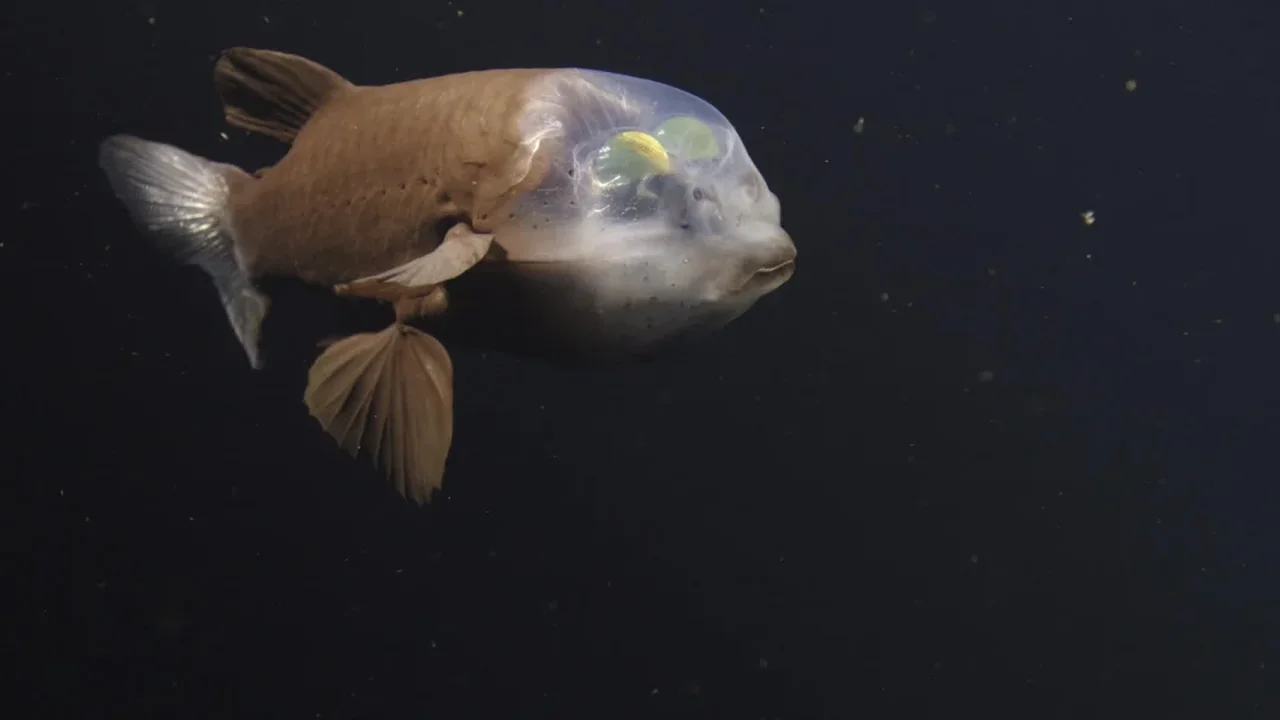
Nearly 600 meters beneath the Pacific Ocean, researchers captured a rare close-up of the barreleye fish, a small deep-sea species with a transparent, fluid-filled head. The footage offers an unusually clear view of an animal encountered only a handful of times during decades of exploration by the Monterey Bay Aquarium Research Institute (MBARI).
The fish's two green, barrel-shaped eyes sit inside its clear dome, while the dark spots above its small mouth are olfactory organs--not a second pair of eyes. Its eyes can rotate, allowing it to look upward for prey and then shift forward as it moves to feed.
A visual system adapted to the deep
In the ocean's dim twilight zone, the barreleye often hovers and scans the water above for drifting food. Researchers suspect that green pigments in its lenses help it distinguish faint sunlight from bioluminescence produced by other animals. Its transparent head may also protect its eyes as it approaches prey among the tentacles of siphonophores, though this feeding behavior has not been fully documented.
Earlier specimens often lost their delicate head coverings during collection, obscuring the fish's unusual anatomy. Remotely operated underwater vehicles now let scientists observe barreleyes in their natural environment. These rare encounters show how advanced ocean exploration can reveal adaptations that were once difficult to study--and may deepen future understanding of life in the deep sea.