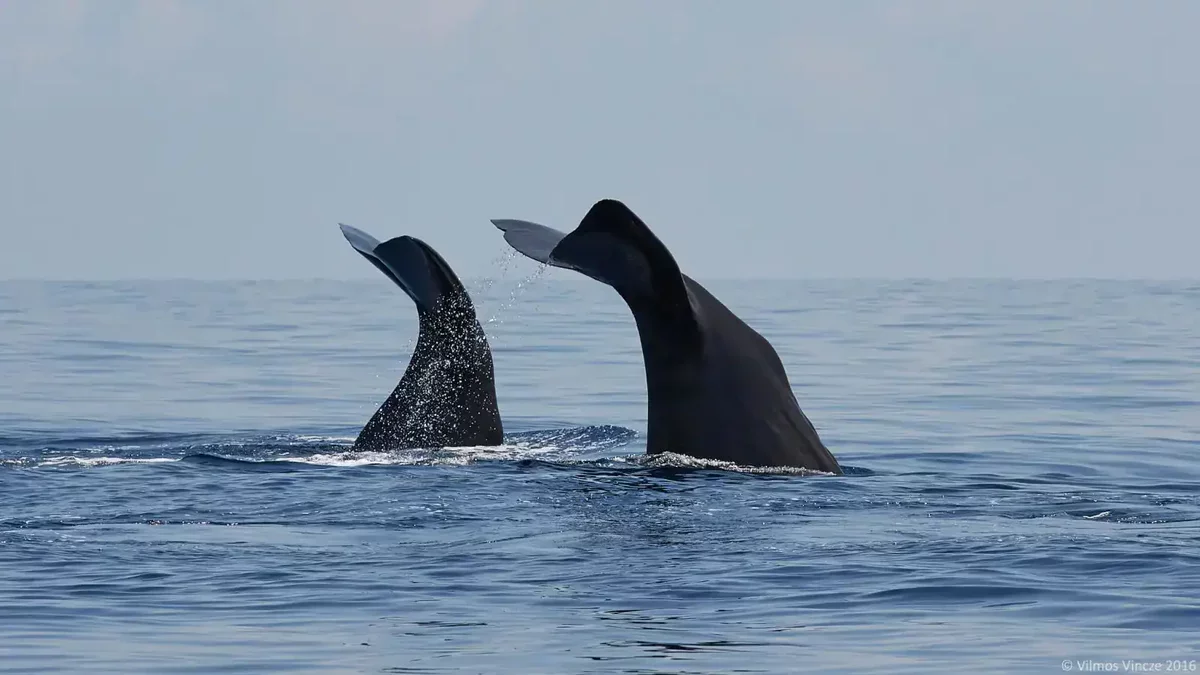
A recent study has unveiled that the "codas" of sperm whales--short sequences of clicks--exhibit a structural intricacy akin to human speech. Researchers have discovered unique linguistic patterns, including sounds resembling vowels and specific articulations, indicating that these magnificent marine mammals have developed a complex communication system independently within the ocean's depths.
In essence, sperm whales possess an alphabet and vowels, forming a language structure that parallels our own.
Understanding Whale Language
The scientific exploration of whale communication began in the 1950s, marked by the recording of their underwater sounds. By the 1980s, researchers identified codas, which appeared to convey meaning. They focused on the rhythm and timing of these clicks, categorizing them based on the number of clicks and the intervals between them. By the early 1990s, it became evident that these patterns were culturally learned, forming a sophisticated language.
However, the depth of this complexity has only recently been appreciated.
Project CETI, a U.S.-based non-profit organization, aims to decode sperm whale communication. Their latest findings indicate that these codas are more language-like than previously thought. While earlier studies suggested that the sounds bore an acoustic resemblance to human vowels, this new research indicates they also function as vowels.
"All five properties show strong parallels to the phonetics and phonology found in human languages, suggesting an independent evolutionary path," explains a team led by linguist Gašper Beguš from Project CETI and the University of California, Berkeley.
The vocalizations of sperm whale codas are thus highly intricate, representing one of the closest analogs to human phonology found in any analyzed animal communication system.
Vowel Systems Comparable to Human Language
Beguš and his team analyzed an extensive dataset of 3,948 codas recorded off the coast of Dominica using advanced digital acoustic tags. This ensured clarity in sound without distortion from water.
The research revealed that sperm whales can produce two categories of sound: a-vowels and i-vowels. An "a-vowel" typically features one prominent resonance peak, while an "i-vowel" contains two, similar to the difference between the sounds in "sat" and "sit."
Notably, a system of rules governs these sounds, resembling human grammar. For example, certain rhythms correspond with specific vowels, just as in English where "a" sounds tend to be longer than "i" sounds. Additionally, individual accents emerge, with some whales communicating more rapidly than others.
Intriguingly, whales exhibit the ability to "slur" sounds, a trait reminiscent of human speech patterns. When transitioning from an "a" sequence to an "i" sequence, the initial click of the new sequence often carries a trace of the previous sound.
This striking similarity to human language opens up fascinating possibilities for future research.
Future Prospects of Whale Communication
The pressing question remains: what are these whales communicating? While researchers have deciphered the structure of their language, a comprehensive dictionary is yet to be established. Understanding whether a coda signifies "hello," "squid," or "stay away" is the next frontier. By identifying the underlying rules and vowels, scientists are poised to unlock the whales' alphabet, paving the way for potential cross-species conversations.
This discovery serves as a humbling reminder that humans are not the only species capable of rich, communicative, and cultural lives. As David Gruber, founder of Project CETI, notes, these whales have possibly been passing knowledge across generations for over 20 million years. With the right tools and curiosity, we may soon uncover the complexities of their language.
The study has been documented in the Proceedings of the Royal Society B.