For many years, scientists have understood that ordinary matter, which includes all atomic structures, constitutes merely 15% of the universe's total matter. The remainder is classified as elusive dark matter. However, even this known fraction didn't seem to fully account for the universe's mass, leaving over half of it unaccounted for.
Recently, a group of astronomers has made a groundbreaking discovery, potentially locating what they believe to be the long-missing matter from the universe--ordinary atoms that originated from the Big Bang but had remained hidden from our observations.
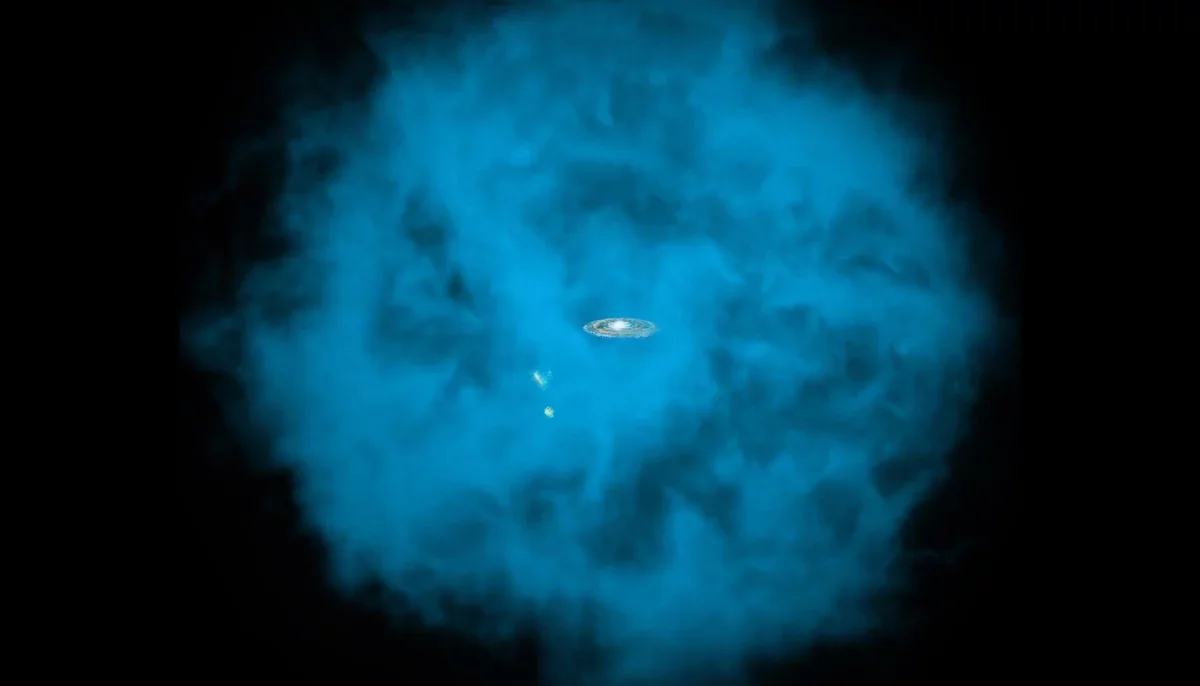
Led by physicist Boryana Hadzhiyska from the University of California, Berkeley, the research indicates that this matter exists as a very diffuse form of ionized hydrogen gas, which has evaded detection until now. "We believe that as we look further from the galaxy, we can recover all the missing gas," Hadzhiyska noted, emphasizing the need for further analysis and simulations to validate their findings.
A Cosmic Revelation
Ionized hydrogen is typically invisible to conventional telescopes. To uncover this hidden matter, the researchers employed a technique utilizing the cosmic microwave background (CMB), the oldest light in the universe. "The cosmic microwave background forms the backdrop of everything we observe in the universe," explained Simone Ferraro, a senior scientist at Lawrence Berkeley National Laboratory.
By analyzing how the CMB light altered as it passed through clouds of ionized gas, the team utilized the kinematic Sunyaev-Zel'dovich effect, which occurs when CMB photons scatter off free electrons associated with galaxy clusters.
The study involved stacking images of approximately 7 million luminous red galaxies collected by the Dark Energy Spectroscopic Instrument (DESI) in Arizona and comparing these with precise CMB measurements from the Atacama Cosmology Telescope (ACT) in Chile. The results revealed that the gas is distributed much more widely than previously thought, extending five times further than earlier estimates.
Implications for Astrophysics
This discovery goes beyond merely resolving a longstanding mystery; it holds significant implications for astrophysics. Traditionally, it has been assumed that black holes become "active" primarily during their early formation, emitting jets of matter and radiation that illuminate galaxies and create quasars. However, the widespread distribution of ionized gas suggests that black holes may interact with their surroundings more frequently than previously understood.
"One unresolved issue relates to active galactic nuclei (AGNs), where it is hypothesized that they intermittently activate in cycles," Hadzhiyska explained. This activity generates feedback, an energy flow from the galaxy's core into space, which influences star formation. The study strengthens previous hints of extensive feedback reported in 2020.
As the new findings undergo peer review in Physical Review Letters, astronomers are eager to refine simulations to align with this enhanced understanding of cosmic feedback and galactic evolution. The quest to locate the universe's missing matter may finally be nearing resolution, revealing that it has always been there, quietly existing just beyond our observational reach.