Spain's 2026 World Cup triumph did more than trigger celebrations -- it also left a measurable mark in the ground. When Ferran Torres scored the decisive extra-time goal against Argentina, seismic instruments across the country picked up the collective movement of fans reacting almost in unison.
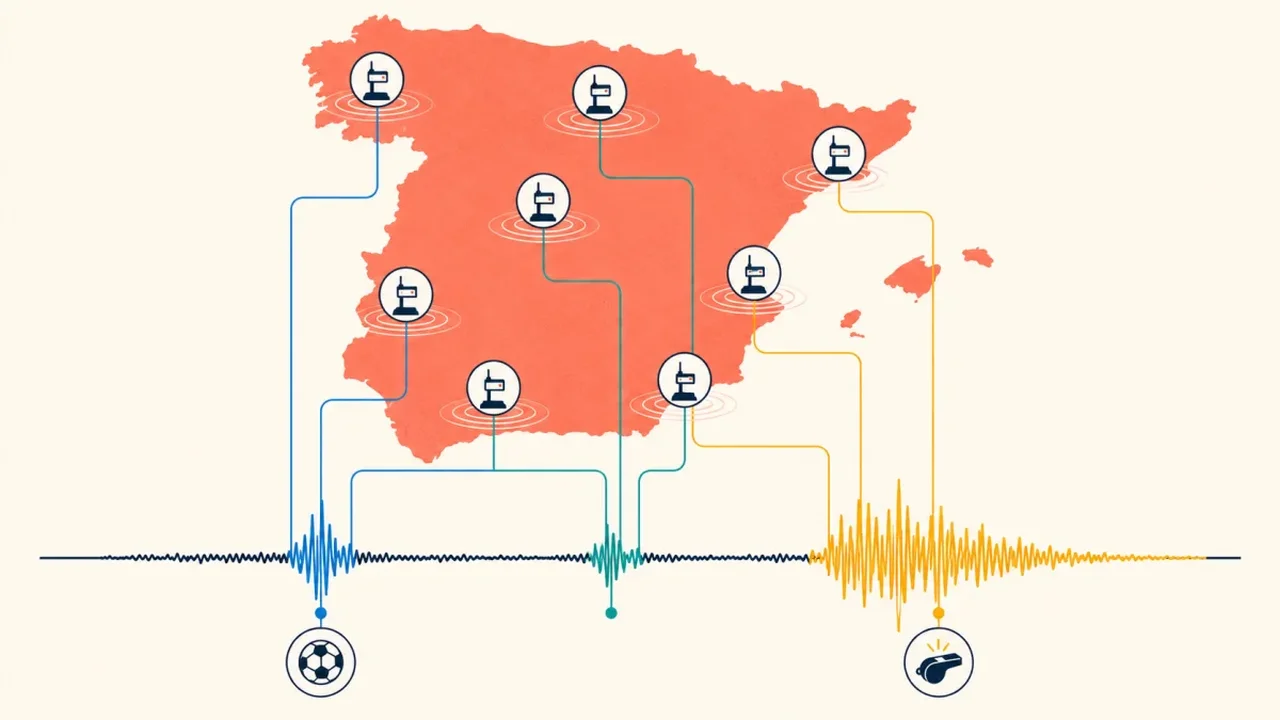
Researchers recorded distinct bursts of vibration in cities including Granada, Barcelona, Lleida, Cádiz, Huelva, and Algeciras. The pattern was captured by networks run by the National Geographic Institute, the Geological and Cartographic Institute of Catalonia, and GEO3BCN-CSIC's Educational Seismic Network.
Three Moments, Three Signals
The data showed a clear sequence: Torres's winning goal, a later disallowed effort by Nico Williams, and the final whistle. The last moment produced the strongest and longest signal, reflecting the wave of celebration that followed confirmation of Spain's second men's World Cup title.
These were not earthquakes in the traditional sense. Instead, they were locally generated vibrations created by thousands of people jumping, stamping, and moving together. Seismometers are sensitive enough to detect even tiny ground motions, making large sporting events surprisingly visible in seismic records.
Similar effects have been observed in other football matches and concerts, where crowd behavior creates unique vibration patterns. In earlier studies, researchers have used passive seismology to distinguish traffic, subway movement, fireworks, and stadium celebrations, showing how everyday human activity can become a useful scientific signal.
For scientists, this kind of event offers a natural laboratory: a shared emotional moment translated into data. For sports fans, it is a reminder that major victories can resonate far beyond the stadium. In the future, these kinds of observations may help expand how cities, crowds, and even underground structures are monitored through passive seismic science.