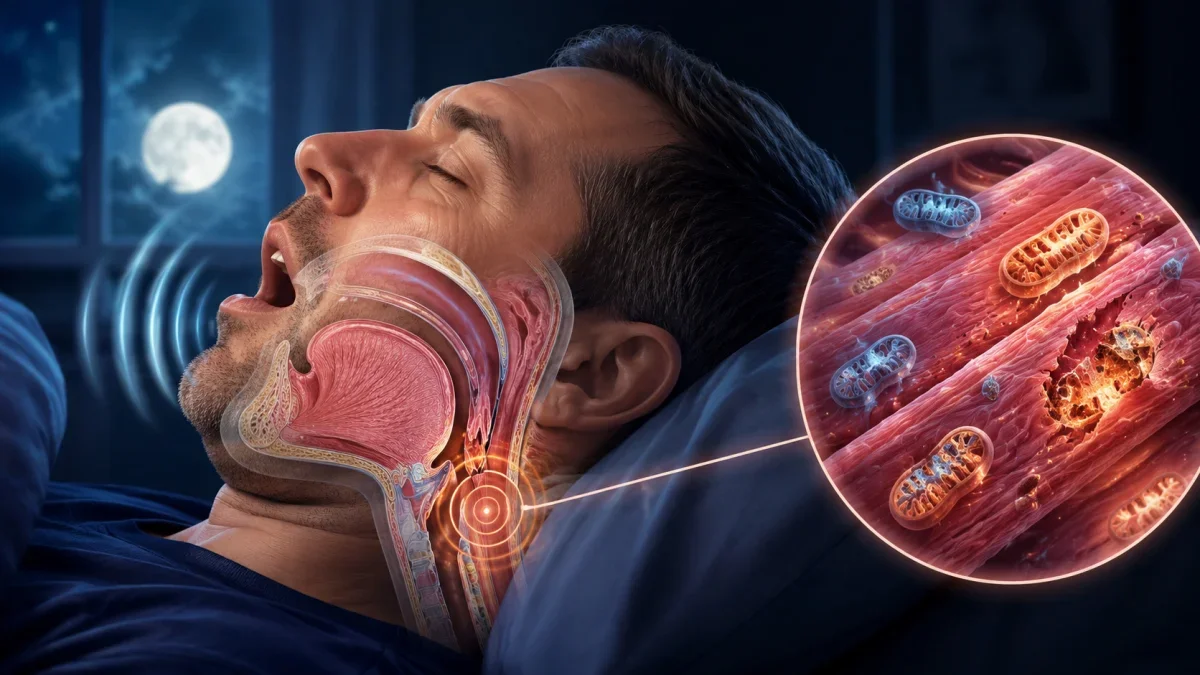
New research indicates that snoring may be more than a nighttime nuisance. According to a study from Umeå University published in Mitochondrion, the repeated vibrations of loud snoring could gradually affect the throat muscles that help keep the airway open during sleep.
The findings suggest snoring may play a dual role in obstructive sleep apnea: it can appear as an early warning sign, but it may also contribute to the condition's progression. Sleep apnea occurs when the upper airway narrows or closes repeatedly during sleep, disrupting airflow and making breathing more difficult.
How the study tested the idea
To explore the mechanism, researchers created a lab model using rat muscle cells exposed to recorded snoring vibrations. After several hours of stimulation, the cells showed signs of stress, including weakened mitochondrial activity and reduced flexibility in how they produced energy.
By 48 hours, some oxygen-use functions had partially recovered, but the cells still struggled to activate backup energy pathways under pressure. The team also found signs that the cells were responding to vibration as a mechanical challenge, yet the repair process did not fully keep pace.
What tissue samples revealed
The laboratory results were compared with upper-airway muscle biopsies from long-term snorers, most of whom had sleep apnea. Those samples showed altered mitochondria, lower activity of a key enzyme, and fewer capillaries feeding the muscle fibers. Together, the data point to a possible link between repeated vibration and muscle health in the airway.
The researchers note that the study does not prove snoring causes sleep apnea on its own. Still, it adds a fresh biological layer to a condition already known for its complex causes. The work suggests that persistent vibration may influence how airway muscles age and function over time.
As sleep science advances, this line of research could help shape earlier detection and more targeted approaches to airway health in the future.