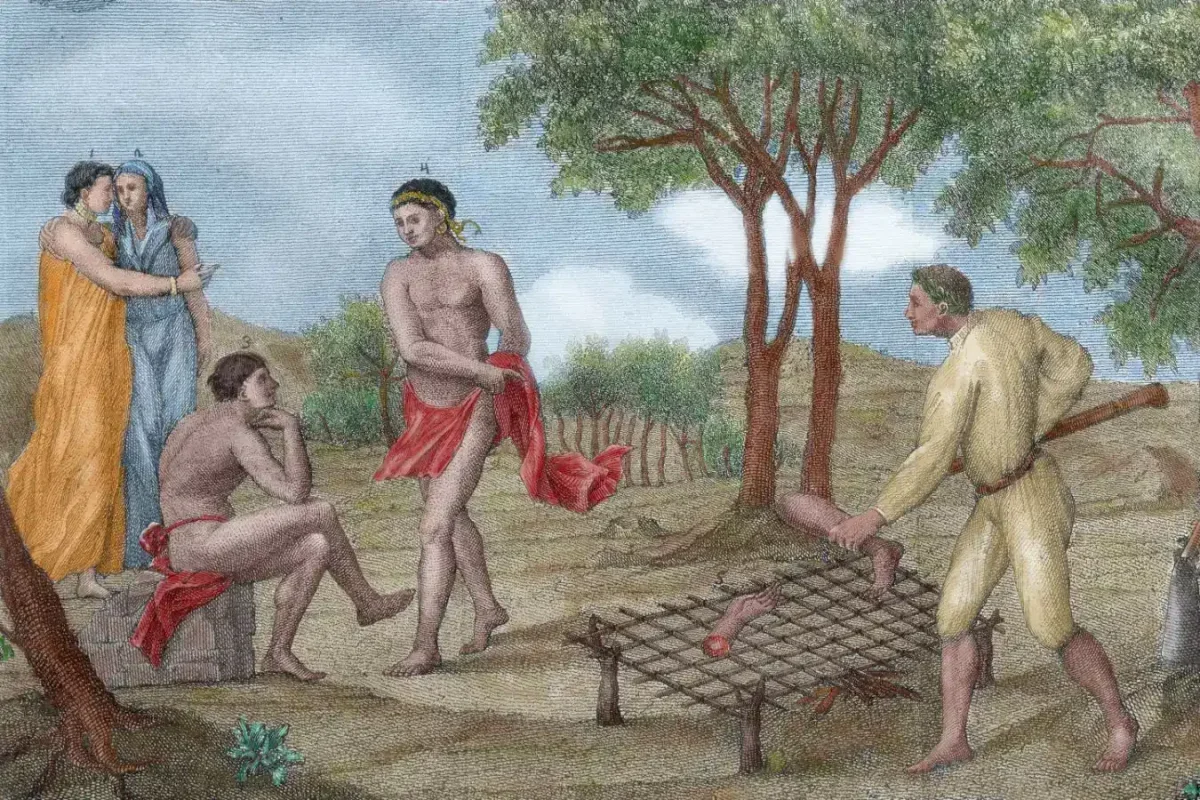
A new modeling study published in the Proceedings of the National Academy of Sciences explores a question that sits at the intersection of biology, evolution, and public health: could cannibalism ever make sense from a survival standpoint?
Researchers Michal Misiak of the University of Wrocław and Petr Tureček of Charles University built a mathematical framework to compare the calories gained from human flesh with the risks tied to injury and infection. Their approach looked at different scenarios, including eating raw or cooked tissue, and whether the person consumed had already eaten human flesh before.
The study draws on the history of kuru, a prion disease that once affected communities in Papua New Guinea and spread through ritual consumption of human tissue. Because prions are misfolded proteins that resist ordinary cooking, they present a uniquely durable transmission risk. That makes human-to-human feeding especially efficient for spreading certain agents compared with many animal-borne infections.
In the model, the nutritional value of a human body was estimated at about 32,376 calories. But once the costs of hunting, preparation, injury, and disease were added, the balance shifted quickly. The researchers found that only in extreme starvation conditions could the practice appear energetically favorable, and even then the margin was narrow. As consumption chains lengthened, the health costs rose sharply.
The broader takeaway is not about shock value, but about how biology can shape cultural boundaries. The study suggests that long-standing taboos may have acted as practical safeguards against infection and survival loss. In that sense, the research offers a clear example of how mathematical models can illuminate the hidden logic behind human behavior. It may also help future science better understand how disease risk, nutrition, and social rules interact in extreme environments.