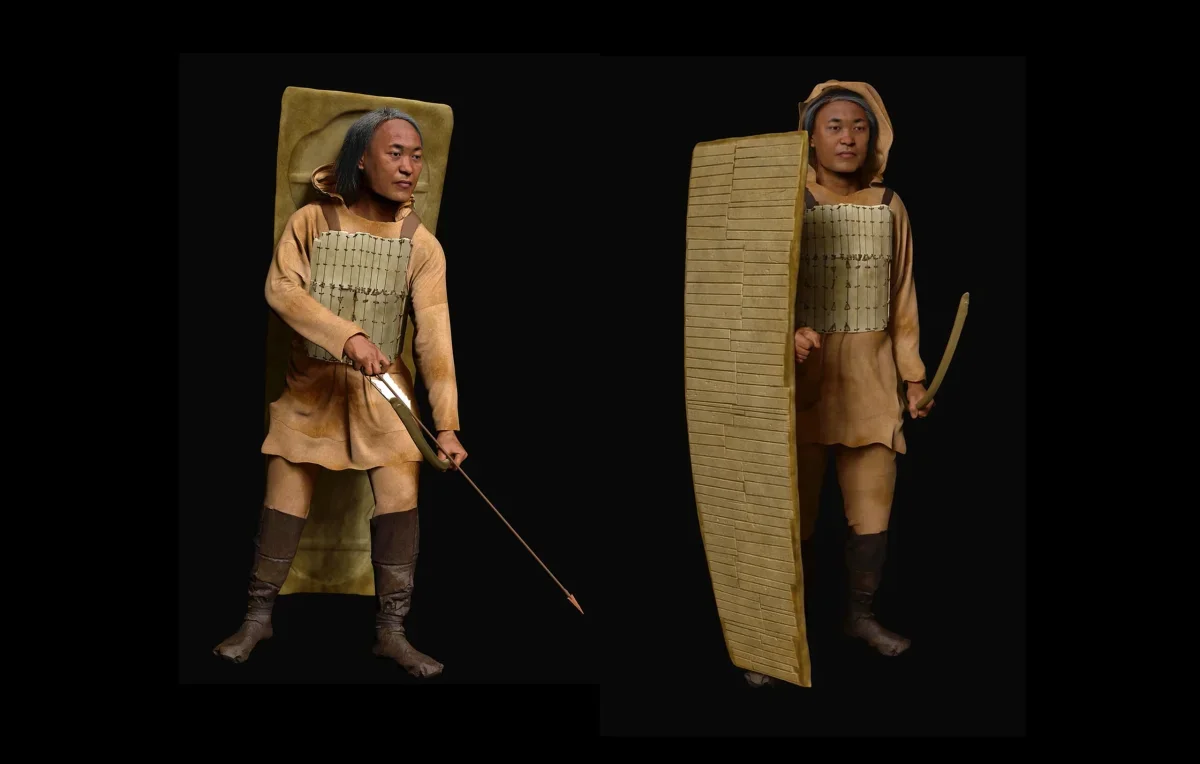
Archaeologists in Russia's Sakha Republic have brought a 4,000-year-old Siberian warrior back into view through advanced digital reconstruction. What began in 2004 as a shallow burial uncovered near Kyordyughen has now become a vivid window into prehistoric life.
A burial built around bone and battle
The man was found beneath a shield assembled from bone plates, likely made from the bones of an Altai wapiti. Arrowheads lodged in several plates suggest the shield had seen combat. His skeleton also showed healed injuries in the arms, legs, shoulder, elbow, and skull, pointing to a physically demanding life centered on archery and survival in the Arctic environment.
Radiocarbon dating places the burial at about 3,800 years old, within the late Neolithic period. The individual is linked to the Ymyyakhtakh culture, a nomadic hunter-gatherer society known for its bone and stone technologies. Though only 165 cm tall, he appears to have held a respected position, as indicated by the weapons, armor, slate adze, and personal items placed with him.
Science restores a face
Researchers at North-Eastern Federal University used photogrammetry, skeletal scans, and facial reconstruction methods associated with anthropologist Mikhail Gerasimov to rebuild the warrior's appearance and equipment. The result is a lifelike portrait that now stands in the university's Museum of Archaeology and Ethnography.
The burial also included a second set of human remains and traces of fire beneath the head, details that suggest ritual meaning and a carefully planned farewell. Preserved by permafrost and shallow burial conditions, the site has offered rare insight into ancient Arctic customs.
More recently, genetic analysis published in the Journal of Human Genetics identified the warrior's paternal lineage as N-L708, a branch still present among some Indigenous peoples of northeast Asia. Together, the archaeological and genetic evidence adds depth to a story that stretches across millennia. This kind of research shows how digital science can keep expanding our understanding of human history and may shape future museum experiences and heritage studies.