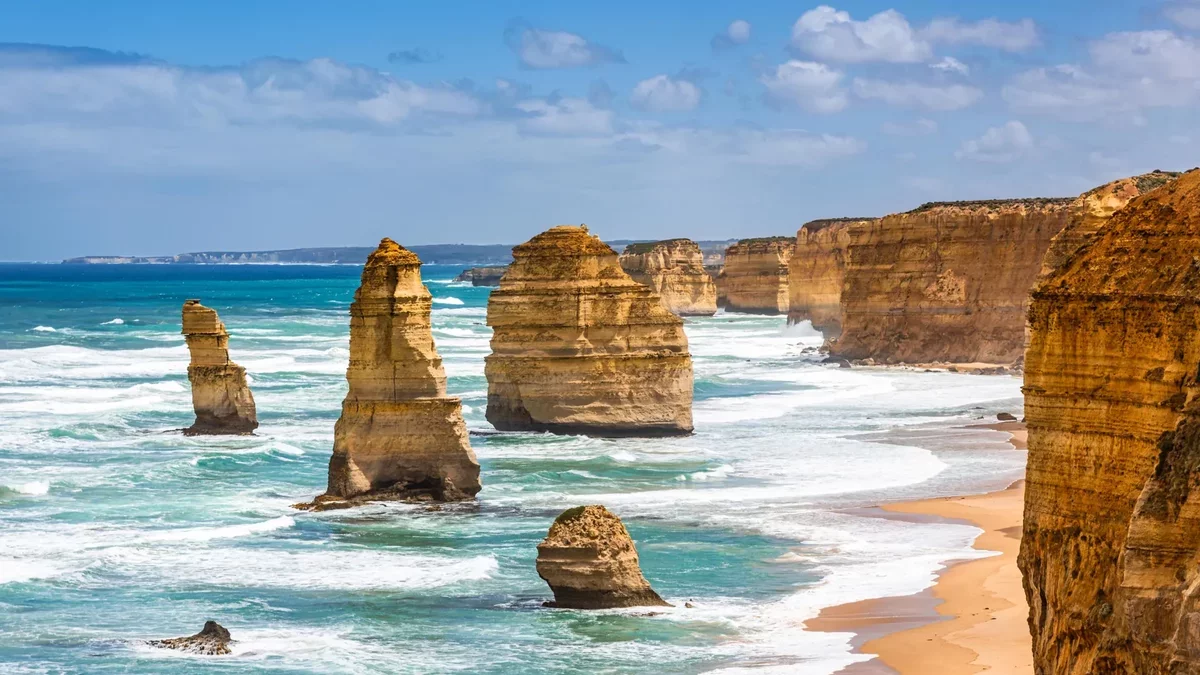
Researchers have made significant strides in understanding the geological history of the Twelve Apostles, a stunning natural landmark along Australia's coastline.
A Natural Record of Ancient Climate and Sea Levels
Leading the study, Associate Professor Stephen Gallagher from the University of Melbourne's School of Geography, Earth and Atmospheric Sciences, noted that tectonic activities have transformed the Apostles into a remarkable archive of historical environmental conditions. "These giant structures act like an environmental time capsule, preserving critical information about the Earth's climate, tectonic shifts, flora, and fauna over millions of years," he explained. Notably, approximately 13.8 million years ago, the climate was significantly warmer than today.
Gallagher emphasized the urgency of this research, stating, "With only eight of the original twelve Apostles remaining, we must study them to gain insights into future climate scenarios."
New Evidence Reveals Younger Age
Recent findings have allowed scientists to more accurately determine the age of the formations. The layered rock structures, akin to tree rings, suggest that the Apostles are younger than previous estimates indicated. "Earlier studies estimated the limestone layers to be between seven and fifteen million years old, but our discovery of microscopic fossils has refined this to an age range of 8.6 to 14 million years," Gallagher stated.
This research was published in the Australian Journal of Earth Sciences.
From Ocean Floor to Coastal Landmarks
The study reveals that while tectonic forces gradually elevated the rock layers over millions of years, the iconic pillars we see today were formed more recently. Following the last Ice Age, rising sea levels and coastal erosion sculpted these towering structures along the shoreline.
Tilted Layers Reveal Ancient Earthquakes
The research team discovered that the uplift was not a uniform process. Rather than rising straight, the rock layers tilted and fractured during their ascent. "Observing the cliffs around the Twelve Apostles today, one can see that the limestone layers are tilted by several degrees, with visible fault lines that document ancient earthquake activity," Gallagher noted.
Ongoing Research Into Past and Future Changes
Scientists are now delving deeper into individual layers to reconstruct historical climates, ocean conditions, and sea levels. This ongoing research holds the potential to elucidate how ancient geological processes continue to shape modern coastlines and influence current erosion patterns.