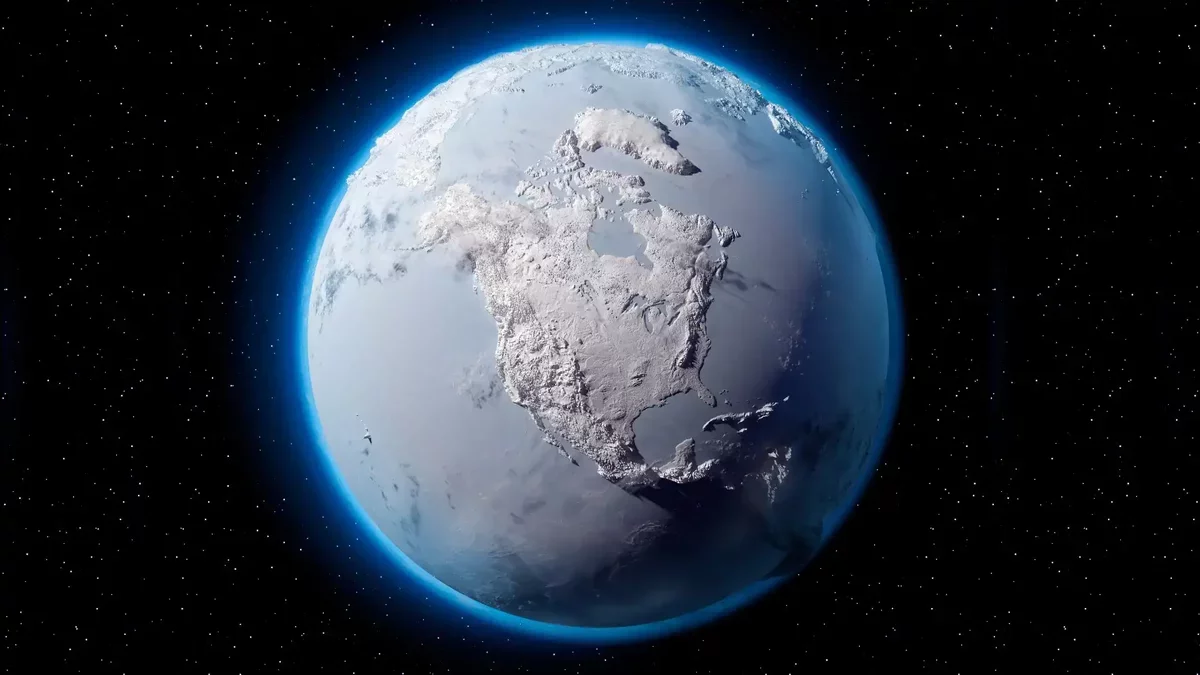
Approximately 717 million years ago, Earth experienced a dramatic freeze, as ice extended from the poles to the equator, transforming the planet into a "snowball Earth." During this period, sunlight was unable to penetrate the thick ice, leading to an alien environment devoid of photosynthesis.
In a recent study published in Nature Communications, researchers revealed the coldest recorded sea temperature from this snowball Earth event, measuring at −15°C ± 7°C. If confirmed, this would mark the lowest sea temperature in Earth's history.
For seawater to remain in a liquid state at such low temperatures, it must possess a high salt concentration. The analysis indicated that certain areas of seawater during the Sturtian glaciation, which lasted about 57 million years, could have been up to four times saltier than today's oceans.
Ross Mitchell, a geologist at the Institute of Geology and Geophysics of the Chinese Academy of Sciences, noted, "We're dealing with salty brines," similar to those found in Antarctica today, but even colder than the salty slush of Antarctica's Lake Vida.
The Sturtian snowball event was a significant climate phenomenon, where ice reflected more sunlight than land or water, leading to a cycle of cooling and further ice formation. This resulted in glaciers that may have reached thicknesses of up to one kilometer.
The unique conditions of this era left behind distinctive iron formations, which accumulate where glaciers meet ice-covered seas. The research team developed a novel method to use these iron deposits as indicators of ancient ocean temperatures.
Iron formations form in waters rich in dissolved iron, and the presence of oxygen converts the greenish ferric iron into solid, rusty red ferrous iron. This process means that most iron formations are ancient remnants from a time when Earth's atmosphere was low in oxygen, or from the snowball Earth period when the oceans were sealed beneath ice.
Researchers found that iron-56, the most prevalent iron isotope, becomes isotopically heavier in colder waters. While the exact temperature during the formation of ancient iron deposits is uncertain, it is believed to have been warmer than during the snowball Earth phase.
Geochemist Andy Heard commented on the study, stating, "It's a very interesting, novel way of getting something different out of iron isotope data." He emphasized that while the findings strongly suggest extremely cold seawater, the precise temperature of −15°C might not be definitive.
Further analysis of strontium and barium isotopes confirmed that the seawater during snowball Earth was significantly saltier than modern ocean water. Jochen Brocks from the Australian National University noted that these findings align with his own salinity studies of snowball Earth sediments, suggesting that the brine could have reached temperatures as low as −7°C before freezing.
"It was very cool to get the additional confirmation it was actually very, very cold," Brocks added.