Cyanobacteria, often hailed as the pioneers of oxygenic photosynthesis, have played a crucial role in shaping life on Earth. Benjamin Springstein, a postdoctoral researcher at the Institute of Science and Technology Austria (ISTA), emphasizes their significance, noting their central role in the Great Oxygenation Event approximately 2.5 billion years ago, which allowed aerobic life to flourish. Today, these organisms continue to be vital, contributing to global biomass and participating in essential carbon and nitrogen cycles.
Among these remarkable organisms, Anabaena sp. PCC 7120 has been a focal point of research for over thirty years, serving as a model for understanding multicellular cyanobacteria. Recent collaborative research involving ISTA, the Institut Pasteur de Montevideo, Kiel University, and the University of Zürich has unveiled a fascinating evolutionary shift in Anabaena. The study reveals that an ancient DNA separation system has been repurposed into a structure that helps define cell shape.
In bacteria like Anabaena, cell division relies on the precise copying and distribution of DNA. This genetic material is tightly organized into chromosomes, which are essential for survival, while plasmids carry additional, often non-essential genes that can transfer between bacteria, facilitating rapid adaptation.
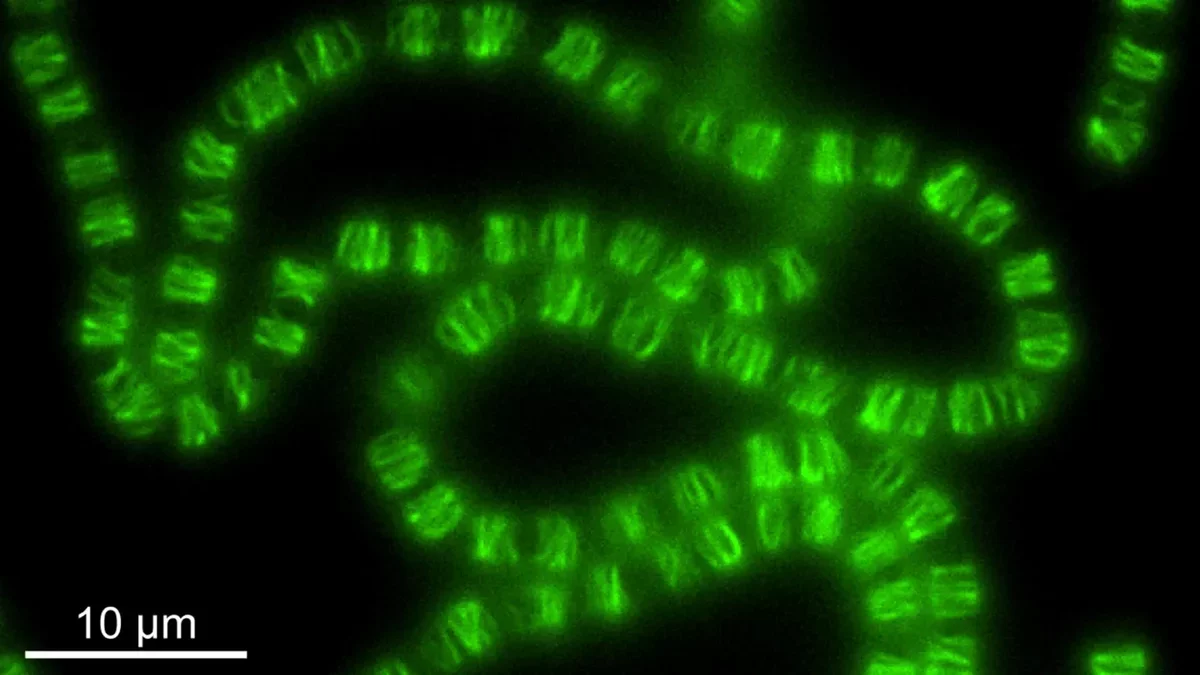
Springstein's exploration of Anabaena since 2014 led to a serendipitous discovery during the COVID-19 pandemic. He noted that Anabaena contains a system called ParMR, traditionally associated with plasmid segregation. However, its presence within chromosomes suggested a potential adaptation for chromosome separation. His experiments revealed that one component, ParR, binds to lipid membranes rather than DNA, while ParM forms filament networks beneath the inner membrane, creating a protein polymer layer resembling a cellular cortex.
Rather than functioning as a conventional DNA segregation system, this newly identified mechanism operates at the membrane level to organize cell structure. To investigate its dynamics, researchers recreated the system outside living cells, observing that the filaments exhibit behaviors akin to microtubules in more complex organisms.
Collaborating with Professor Florian Schur and PhD student Manjunath Javoor at ISTA, the team utilized cryo-electron microscopy to analyze the filament structures. They discovered that unlike similar systems in other bacteria, Anabaena's filaments are bipolar, allowing growth and shrinkage from both ends.
The significance of this system became evident when it was removed from living cells. Cells lacking this mechanism lost their characteristic rectangular shape, becoming round and swollen, indicating that its primary role is to maintain cell structure rather than merely managing DNA distribution. This led researchers to rename the system CorMR.
Through bioinformatic analysis, the research team traced the evolutionary journey of the CorMR system, revealing that it transitioned from a plasmid-based mechanism to a chromosomal one, ultimately gaining the ability to bind to cell membranes and control cell shape. This transformation exemplifies how evolution can repurpose ancient biological systems for new functions.