Dr. Michał Karpiński, head of the Quantum Photonics Laboratory at the University of Warsaw, emphasizes the significance of quantum key distribution (QKD) in establishing secure cryptographic keys through single photons. While traditional QKD relies on qubits -- the fundamental units of quantum information -- researchers are now exploring multidimensional encoding to meet the demands of advanced applications. This innovative approach utilizes complex quantum states that can represent multiple values.
At the laboratory, scientists are investigating time-bin superpositions of photons. In this framework, a photon can exist in a state that combines being "early" and "late," with the detection time being random. The information is encoded in the phase relationship between these light pulses.
Dr. Karpiński notes, "While previous research focused on detecting superpositions of two pulses, we are expanding our interest to include configurations with more time bins, ranging from two to four or even beyond."
Harnessing the Talbot Effect for Quantum Communication
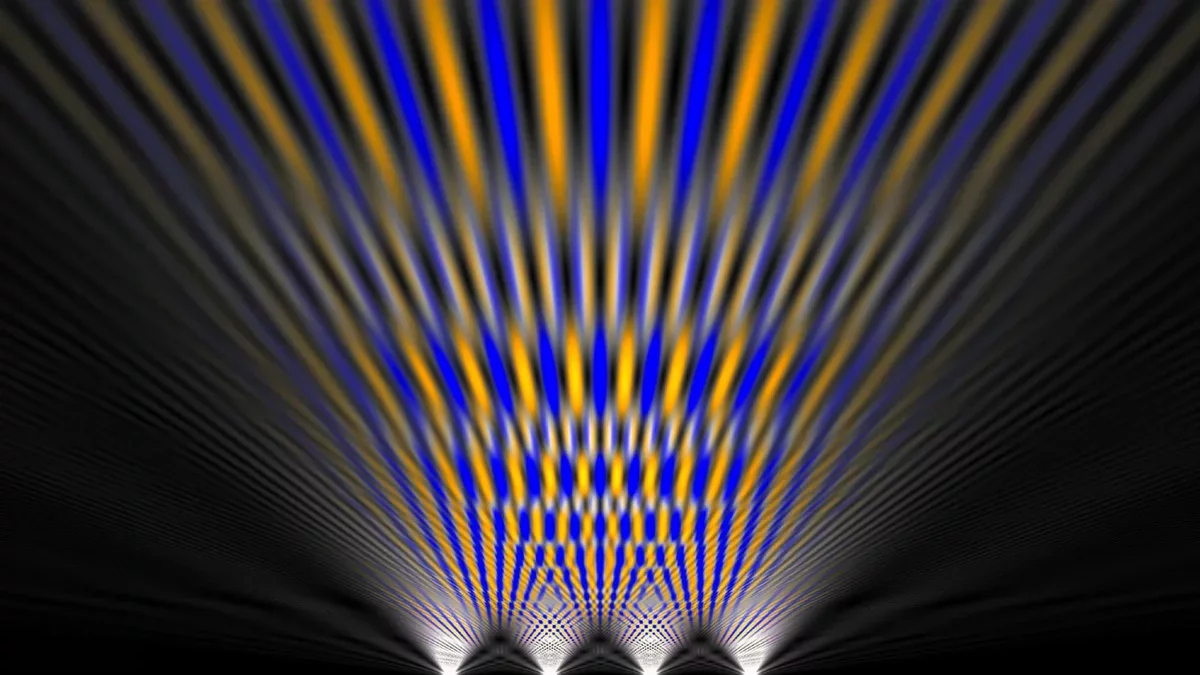
The research team has turned to the Talbot effect, a classical optics phenomenon first described by Henry Fox Talbot in 1836. This effect allows light passing through a diffraction grating to repeat its image at regular intervals, effectively 'reviving' at certain distances. Remarkably, this phenomenon can also occur over time when a consistent stream of light pulses traverses a dispersive medium like optical fiber, as explained by Maciej Ogrodnik, a PhD student at the Faculty of Physics.
By applying the Talbot effect to sequences of light pulses, including single photons, the researchers have developed a system where signals can reconstruct themselves over time as they travel through optical fiber. The interference of these pulses, influenced by their phase, enables the identification and measurement of various quantum states.
Streamlined Quantum Key Distribution System
The team has successfully constructed an experimental QKD system capable of operating in four dimensions. Notably, the system utilizes commercially available components, requiring only a single photon detector to register superpositions of multiple pulses. Adam Widomski, a PhD student, highlights that this design significantly reduces both cost and complexity, eliminating the need for frequent calibration of the receiver, a common challenge in traditional QKD systems.
In contrast to conventional methods that rely on multi-interferometer setups, this new approach ensures that all photon detection events are productive, enhancing efficiency. While there are some measurement error rates, these do not hinder QKD's effectiveness, as confirmed by collaborations with quantum cryptography theorists.
Testing and Security Enhancements
The new system has been rigorously tested in laboratory fiber setups and across the University of Warsaw's existing fiber network. The results validate the higher information efficiency of the system, demonstrating successful QKD with two- and four-dimensional encoding.
To further bolster security, the researchers collaborated with experts from Italy and Germany. Their findings revealed vulnerabilities in existing QKD protocols, leading to modifications that enhance data collection and security. The security proof for this new protocol has been published in Physical Review Applied.
Advancing Quantum Photonics Expertise
This project not only introduces a groundbreaking communication method but also enhances the University of Warsaw's expertise in advanced quantum photonics. Conducted under the QuantERA international program, the research utilized facilities at the National Laboratory for Photonics and Quantum Technologies.
As quantum technologies continue to evolve, these advancements in QKD could redefine secure communication, paving the way for a future where quantum encryption becomes the standard for safeguarding sensitive information.