Advancements in the manipulation of light at minuscule scales are paving the way for the next generation of technology. As conventional electronics approach their limits, the field of photonics emerges as a promising alternative, utilizing light instead of electrons for data transmission. This shift could lead to devices that are not only faster but also more compact, heralding a new era of powerful technologies.
Overcoming Wavelength Limitations
Light exhibits dual characteristics as both a particle and a wave, which imposes a limitation based on its wavelength. Each type of light possesses a specific wavelength that dictates the size of structures capable of effectively controlling it. For instance, visible light has wavelengths in the hundreds of nanometers, while infrared light can extend to a micrometer or more. This raises a crucial question: is it possible to confine light within structures smaller than its own wavelength?
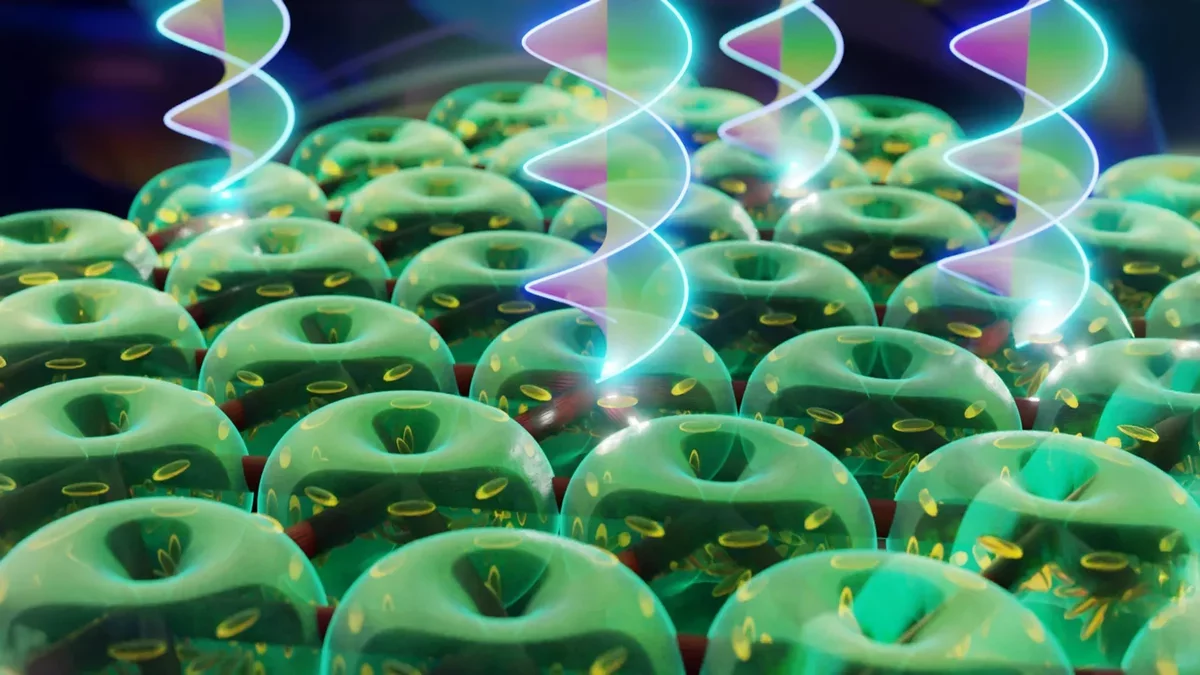
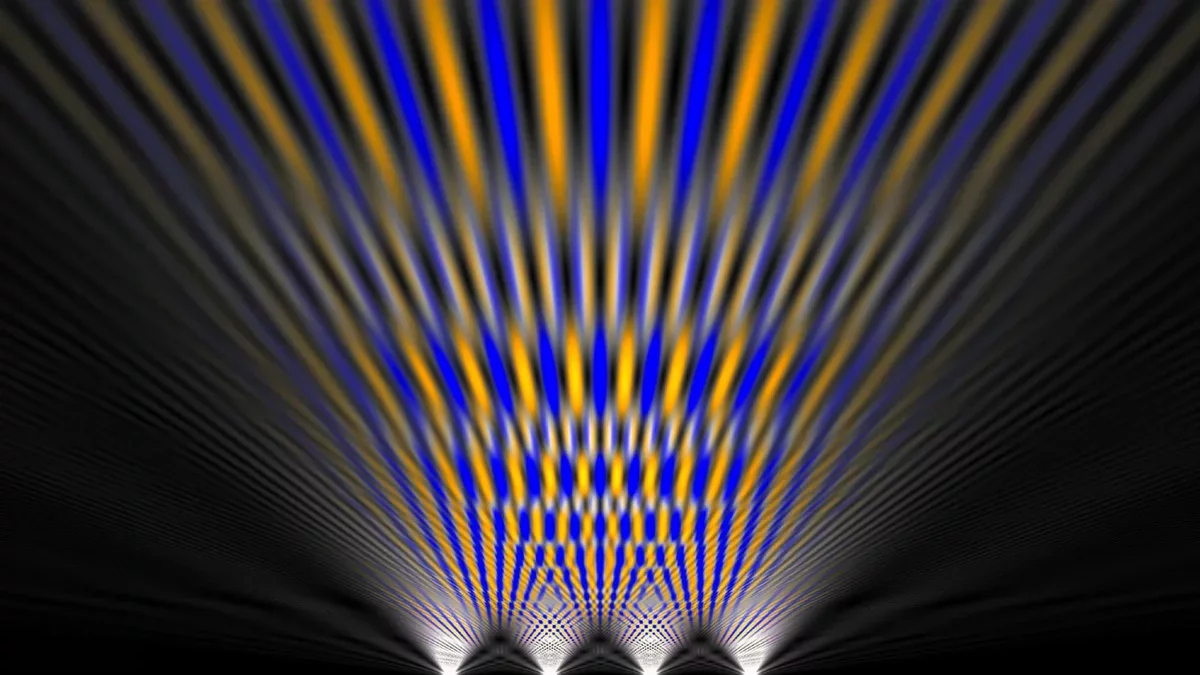
A research team has successfully demonstrated this capability by engineering a subwavelength grating that traps infrared light within a mere 40 nanometer thick layer. This innovative structure comprises closely spaced parallel strips that interact with light in a manner akin to a prism. When these strips are positioned closer than the wavelength of light, they function as a near-perfect mirror, effectively containing the light within an extremely small volume.
The Advantages of Molybdenum Diselenide
Previous iterations of such gratings, constructed from materials like silicon or gallium compounds, required thicknesses of several hundred nanometers to operate effectively. Reducing their size compromised their ability to confine light. The breakthrough here lies in the use of molybdenum diselenide (MoSe2), which boasts a significantly higher refractive index. In simple terms, light travels slower in this material compared to others. While it slows by approximately 1.5 times in glass and around 3.5 times in silicon, it slows by about 4.5 times in MoSe2. This enhanced slowing effect allows for a dramatic reduction in size while still efficiently trapping light, resulting in a layer that is over a thousand times thinner than a human hair.
Transforming Infrared Light
MoSe2 also offers additional benefits. It forms layered structures, similar to graphene, but functions as a semiconductor. It exhibits nonlinear optical behavior, including a phenomenon known as third harmonic generation, where three infrared photons merge to create a single photon of higher frequency, converting infrared light to visible blue light. The grating's ability to concentrate infrared light makes this conversion remarkably efficient, with a strength more than 1,500 times greater than a flat layer of the same material.
Another significant advancement is in the production method of MoSe2. Previously, thin layers were created through exfoliation, akin to peeling layers off a crystal, which was inconsistent and limited to small areas. The research team utilized molecular beam epitaxy (MBE), a reliable method for growing semiconductor layers, enabling them to produce large, uniform MoSe2 films while maintaining a thickness of just 40 nanometers.
Implications for Future Technologies
The findings suggest that molybdenum diselenide could transform the manipulation of light in future technologies. Structures no longer need to be thick for effective light control; ultra-thin layers can achieve similar, if not superior, results. This scalable production method paves the way for practical applications, such as photonic integrated circuits, making the future of light-based technology increasingly promising.