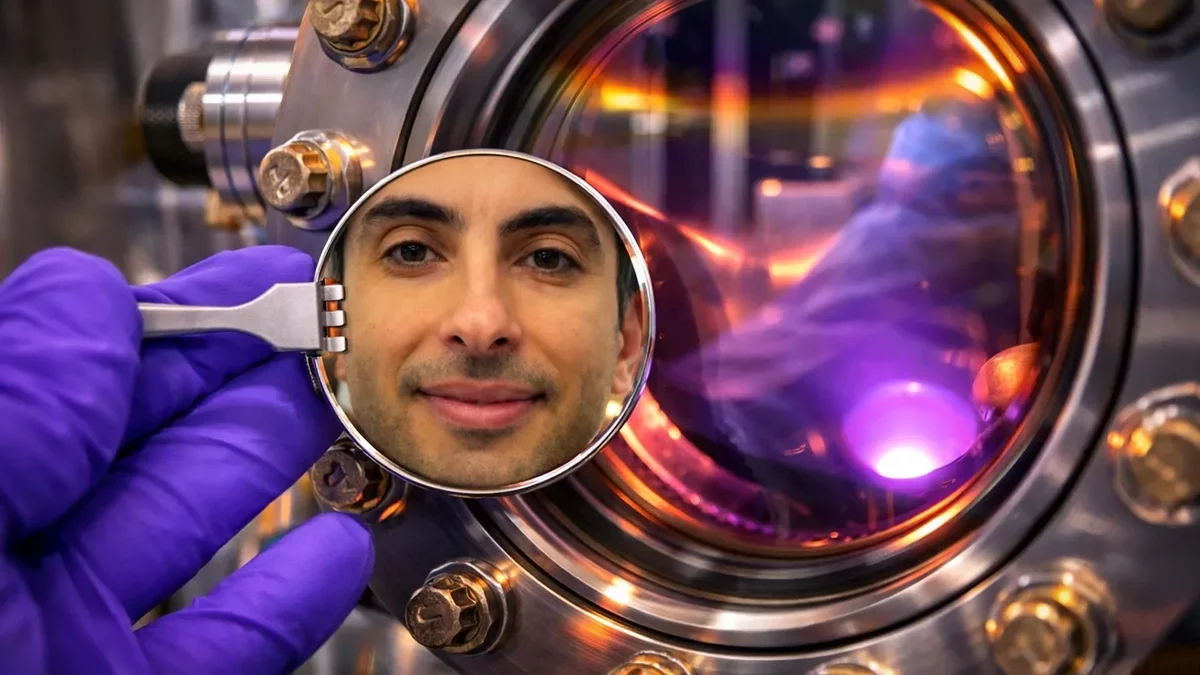
A research team from the University of Cambridge has unveiled an innovative brain-like chip that could significantly lower energy usage in artificial intelligence applications. This advanced chip utilizes a modified form of hafnium oxide to create a stable, low-energy 'memristor', designed to emulate the neuronal connections and communications found in the human brain. The team's findings were published in the journal Science Advances.
The Energy Dilemma in AI
Current AI technologies predominantly depend on traditional computer chips that necessitate constant data transfers between memory and processing units. This incessant movement of data consumes substantial electricity, a demand that escalates as AI technologies proliferate across various sectors.
In contrast, neuromorphic computing presents a promising alternative. By integrating memory and processing into a single unit, akin to the brain's functionality, this approach has the potential to slash energy consumption by up to 70%. Furthermore, it enables systems to learn and adapt more fluidly.
"Energy consumption poses a significant challenge for existing AI hardware," stated Dr. Babak Bakhit, the lead author from Cambridge's Department of Materials Science and Metallurgy. "To tackle this, devices must exhibit extremely low currents, exceptional stability, and the ability to switch between multiple states effectively."
Innovative Memristor Design
Most conventional memristors operate by generating tiny conductive filaments within metal oxide materials. However, these filaments can behave erratically and often require high voltages, limiting their scalability for larger computing systems.
The Cambridge team took a novel approach by engineering a hafnium-based thin film that transitions between states through a more regulated mechanism. By incorporating strontium and titanium and employing a two-step growth method, they created electronic gates, referred to as 'p-n junctions', at the layer interfaces.
Rather than depending on filament formation, the device alters its resistance by modifying the energy barrier at these junctions, resulting in smoother and more reliable switching.
Bakhit, also associated with Cambridge's Department of Engineering, emphasized that this design addresses a critical challenge in memristor technology. "Filamentary devices often exhibit random behavior, but our interface-switching devices demonstrate remarkable consistency across cycles and devices," he noted.
Low Power Consumption and Brain-Like Learning
Testing revealed that the newly developed devices function at switching currents approximately a million times lower than some traditional oxide-based memristors. They can also maintain hundreds of stable conductance levels, crucial for analog 'in-memory' computing.
In laboratory trials, the devices exhibited stability through tens of thousands of switching cycles and retained programmed states for about a day. They also displayed essential biological learning behaviors, including spike-timing dependent plasticity, which enables neurons to modify their connections based on timing.
"These attributes are vital for hardware that aims to learn and adapt rather than merely store information," remarked Bakhit.
Future Challenges and Opportunities
Despite these exciting advancements, challenges remain. The current manufacturing process requires temperatures around 700°C, exceeding standard semiconductor fabrication limits.
Resolving this issue could pave the way for integrating this technology into practical chip-scale systems. "If we can achieve lower temperatures and incorporate these devices onto a chip, it would mark a significant leap forward," he added.
A Journey of Persistence
The breakthrough followed years of experimentation and numerous setbacks. Bakhit noted that progress accelerated late last year when he adjusted the fabrication process by introducing oxygen after forming the initial layer.
"I dedicated nearly three years to this project, encountering many failures. However, by late November, we achieved our first promising results. While it's still early, overcoming the temperature challenge could revolutionize technology by drastically reducing energy consumption while enhancing device performance," he concluded.
This research has received support from the Swedish Research Council (VR), the Royal Academy of Engineering, the Royal Society, and UK Research and Innovation (UKRI). A patent application has been submitted by Cambridge Enterprise, the university's innovation arm.