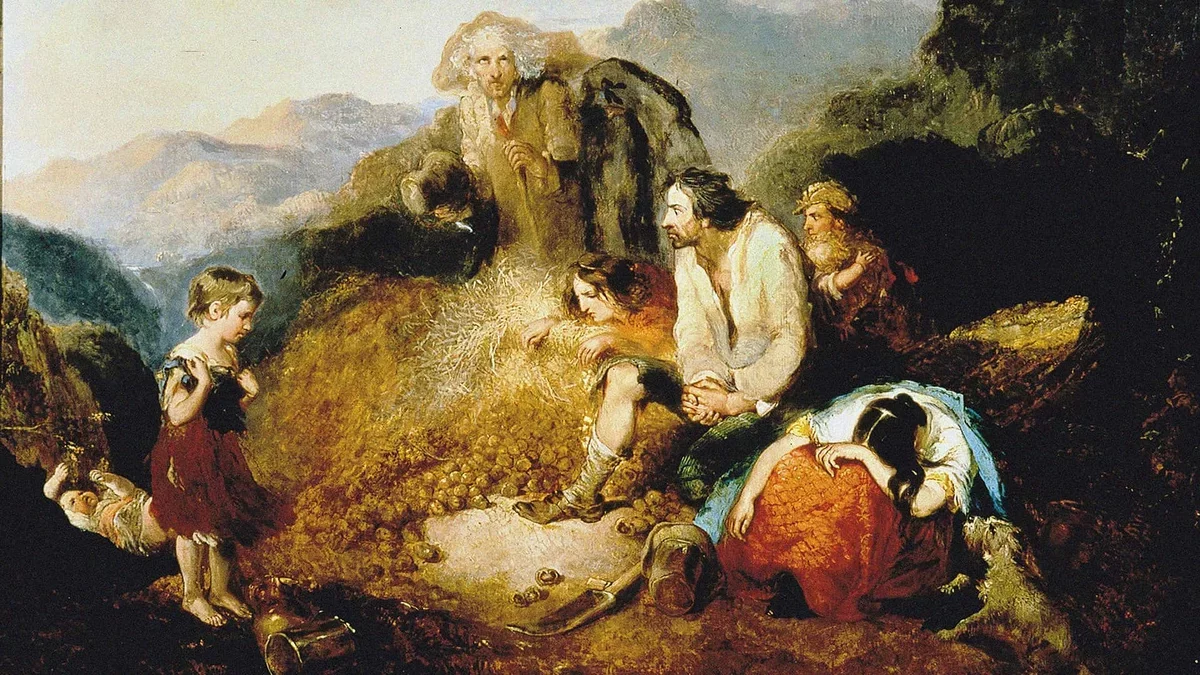
In the mid-1800s, a microscopic foe ravaged Ireland, leaving devastation in its path. This potato blight, caused by the pathogen Phytophthora infestans, led to a famine that claimed over a million lives and displaced countless others. For more than a century, scientists have speculated about the origins of this perilous organism. Did it originate in the rugged Andes, where potatoes were first cultivated, or in the highlands of Mexico, known for similar pathogens?
Recently, a team of researchers has provided clarity on this long-standing question. In a significant genetic study, they traced the potato blight back to the Andes. This discovery not only resolves a critical debate but also unveils a complex narrative of evolution, migration, and hybridization that has influenced the history of one of the world's most notorious plant diseases.
A Pathogen's Journey
Even today, Phytophthora infestans continues to devastate potato and tomato crops globally, resulting in billions of dollars in losses annually. Understanding its origins could aid scientists in forecasting and managing future outbreaks.
The origins debate has been intense, with some researchers advocating for a Mexican birthplace due to the pathogen's sexual reproduction in that region. Others, pointing to genetic evidence, suggested an Andean origin. The latest study, spearheaded by Allison Coomber and Jean Ristaino from North Carolina State University, brings forth extensive genomic data. By 2026, this data will be incorporated into global "Pathogen GPS" systems, enabling farmers to monitor blight migration in real-time using portable DNA sequencers.
The research team examined whole-genome sequences from P. infestans and six related species, including P. andina and P. betacei from South America, as well as P. mirabilis and P. ipomoeae from Mexico. They also analyzed historical samples of P. infestans collected during the Irish Potato Famine.
The findings were definitive. The Mexican species formed distinct genetic groups, separate from P. infestans. In contrast, P. infestans was closely linked to its Andean relatives. This indicates a complex relationship among these species, resembling siblings rather than distant cousins.
"This is how science progresses," stated Jean Ristaino, co-author of the study and professor at North Carolina State University. "There's a hypothesis, it gets tested, and over time, the evidence strongly supports the Andes as the origin, as the DNA reveals the truth." Ristaino's team has utilized this "ancestral map" to identify specific resistance genes in wild Andean potatoes that had previously been overlooked.
Historical records also align with the Andean origin. "When the blight struck Europe and the U.S. in 1845, there were immediate efforts to trace its source," Ristaino elaborated. "Reports indicated that the disease had been recognized among the indigenous Andean communities who cultivated potatoes."
The Andean Crucible
Genetic analysis indicates that the common ancestor of P. infestans and its Andean relatives diverged from the Mexican species around 5,000 years ago. Over time, P. infestans spread from the Andes to various parts of the globe, including Mexico and Europe, facilitated by increased trade and globalization.
The study also uncovered significant gene flow between P. infestans and its Andean counterparts, suggesting that the Andean region is not only the birthplace of P. infestans but also a hotspot for ongoing evolutionary activity.
One of the most fascinating discoveries was the close genetic relationship between P. infestans, P. andina, and P. betacei. These Andean species often hybridize, generating new genetic combinations. This dynamic could lead to new strains with varying virulence traits, some potentially capable of overcoming plant resistance.
Understanding the origins of the potato blight has crucial implications for managing this disease, which remains a global challenge. The blight continues to impact crops worldwide, with emerging strains necessitating innovative solutions from farmers.
As of early 2026, the European Union's new regulations on "New Genomic Techniques" (NGT) have come into effect, allowing for the expedited use of gene-edited crops. This policy shift, informed by the Andean origin study, focuses on "cisgenics"--transferring resistance genes from wild Andean potatoes directly into commercial varieties.
"Knowing the origin of a pathogen is key to finding resistance," Ristaino emphasized. "Long-term management of this disease relies on host resistance, and our research highlights the need to focus breeding efforts back in the Andes."
Initial large-scale field trials of these "triple-R-gene" potatoes have shown nearly complete immunity to the blight, even in the most challenging conditions.
The findings were published in the journal PLOS ONE.
This article was originally published on February 17, 2025, and has been updated with additional information.