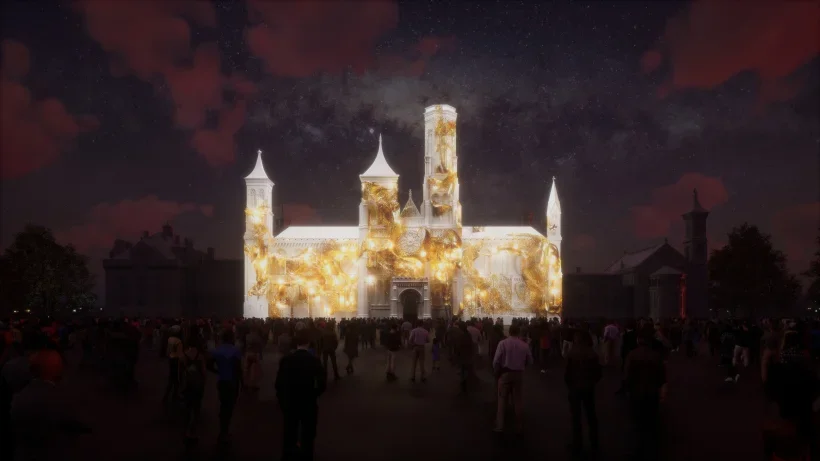
Media artist Refik Anadol is preparing a large-scale AI installation at the Smithsonian Castle in Washington, D.C., extending his exploration of how data can become immersive art. The project, titled Smithsonian Dreams, will be presented on July 17 and 18 at 9 p.m. as a light, sound, and visual performance across the building's facade.
Created in partnership with the Smithsonian Institution, the work uses a custom AI system trained on 200 years of Smithsonian collections and research. Millions of digitized items, including specimens, manuscripts, photographs, artworks, objects, and scientific records, are reinterpreted through a visualization process based on the UMAP algorithm.
Anadol describes data as a form of memory, and this project continues that idea by turning an archive into a living, responsive experience. The concept follows the path of his earlier work Unsupervised, which transformed museum collection data into a continuously evolving visual composition.
With this installation, the Smithsonian Castle becomes both a historic landmark and a digital canvas, showing how artificial intelligence can expand the language of public art. Projects like this suggest a future where cultural institutions use machine intelligence to create new forms of shared experience.