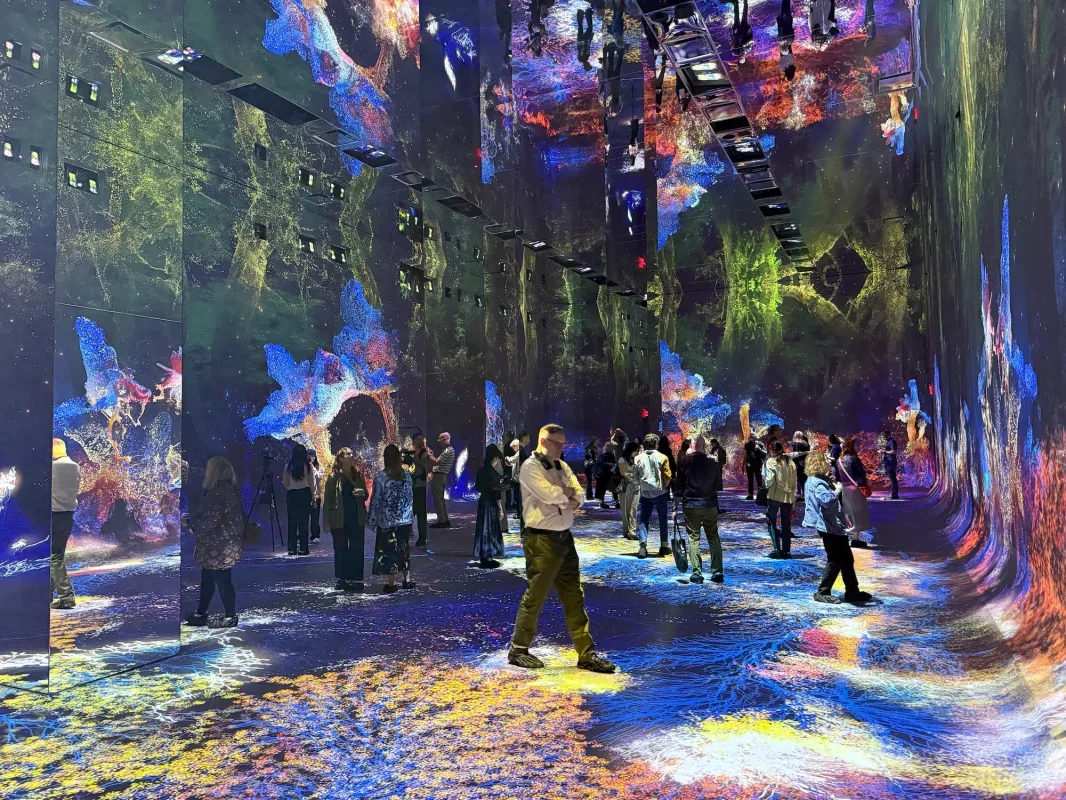
LOS ANGELES -- As I stepped onto the escalator leading into a vast, mirrored environment, I was enveloped by stunning light projections that transitioned from sharp cyber-graphics to intricate mycelial networks, and then to vibrant flora. A powerful soundtrack evolved from ambient tones to dynamic crescendos, interspersed with the sounds of chirping birds and monkey calls. The aroma of a moist forest floor was released from a device I wore, enhancing the experience. It was both thrilling and overwhelming.
This was my introduction to Dataland, heralded as the "world's first museum of AI Arts," co-founded by media artist Refik Anadol and Efsun Erkılıç, officially opening to the public on June 20. Anadol is known for his captivating yet sometimes criticized AI-generated data visualizations. The inaugural exhibition, Machine Dreams: Rainforest, offers an immersive journey through 1.2 billion data points related to nature, creating a multi-sensory exploration that prioritizes data as a centerpiece rather than merely a tool for storytelling.
Located within the 25,000-square-foot Grand LA, designed by Frank Gehry, Dataland shares its vicinity with notable cultural landmarks like the Broad Museum and Disney Concert Hall. Its operational model resembles that of theme parks, focusing on creating engaging experiences, with ticket prices ranging from $49 to $129.
The foundation of Dataland is its Large Nature Model (LNM), an AI system trained on one of the largest nature datasets, developed in collaboration with institutions like the Smithsonian and the Cornell Lab of Ornithology. The data collected from 16 rainforests worldwide is compiled in the Living Encyclopedia, available to the public for a monthly fee, transitioning to free access starting June 20.
Dataland emphasizes its commitment to ethical AI and sustainability, utilizing Google Cloud infrastructure that operates on 87% carbon-free energy. Each visitor's experience generates minimal energy consumption, comparable to a smartphone charge.
While Dataland makes its data accessible, details regarding its financial operations remain undisclosed, as it operates as a for-profit entity. Notable partners include NVIDIA, Google Cloud, and L'Oréal Luxe, with oversight from the RAS AI Foundation, which supports philanthropic initiatives and public engagement.
Visitors can engage with the LNM in the "Latent Gallery," where interactive displays allow exploration of global flora and fauna. This experience, although visually stimulating, raises questions about knowledge retention amidst the sensory overload.
The gallery "The Dream of Ruwe Pinu," inspired by Anadol's experiences in the Amazon, features a projection of a mythical hummingbird, blending cultural narratives with environmental themes. Finally, "The Sanctuary" utilizes biometric data collected during the visit to create a visual representation of visitors' emotional states, presenting a unique but controversial approach to data engagement.
As I exited, I encountered Qualia, a robotic arm that creates abstract paintings daily, serving as a reminder of the intersection between technology and human creativity.
Dataland represents a bold step into the future of art and technology, inviting us to reconsider our relationship with data and nature while fostering a new cultural experience.