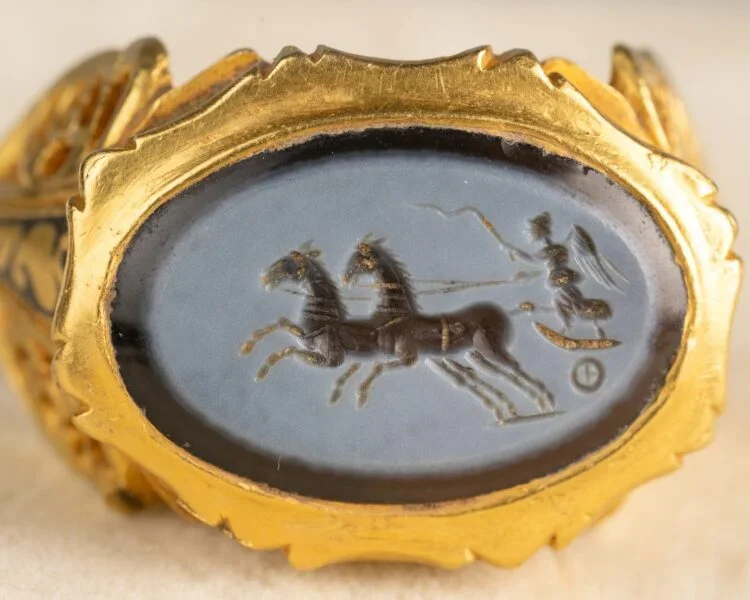
Kevin Minto, a lorry driver and passionate metal detectorist, made an astonishing find in a Somerset field: a remarkable Roman gold ring weighing nearly 48 grams (1.7 ounces). Initially expecting to uncover a corroded coin, Minto was taken aback when his metal detector signaled the presence of this extraordinary artifact.
Dating back approximately 1,700 years, the ring, now referred to as the Ilminster Ring, showcases an intricately engraved gemstone that depicts Victoria, the Roman goddess of victory, commanding a two-horse chariot. Experts herald this discovery as one of the most significant pieces of Roman jewelry unearthed in Britain.
Archaeologists believe the ring was buried around 297 C.E., alongside a hoard that included 297 Roman coins, pottery, and lead objects. The original owner likely intended to reclaim it later, but circumstances prevented their return.
Symbol of Status and Power
The Ilminster Ring stands out with its broad, heavy gold band and a bluish-gray gemstone, which features a detailed intaglio carving. This technique involves engraving the design into the stone, a method that adds depth to its artistry. The imagery of Victoria, adorned with wings and a helmet, symbolizes military triumph and imperial authority.
Amal Khreisheh, a senior curator at the South West Heritage Trust, remarked on the ring's exquisite craftsmanship, noting its combination of size, weight, and intricate design makes it a rare find, comparable only to discoveries made on the continent.
Given the substantial amount of gold, researchers speculate that the owner was likely a person of high status, such as a governor or wealthy merchant, who may have worn the ring for ceremonial or significant public events.
A Glimpse into Roman Britain's Turbulent Past
The ring was buried during a tumultuous period in Roman Britain, known as the Carausian Revolt, which lasted from 286 to 296 C.E. This era was marked by political instability and isolation from the broader Roman Empire, leading many wealthy individuals to bury their valuables for safekeeping.
Khreisheh noted, "The discovery of the Ilminster Ring provides insight into how the Roman inhabitants of south Somerset navigated a time of unrest." It likely reflects the urgent need for security amid the chaos of that decade.
Since its discovery, Minto, who began metal detecting to stay active, has found numerous Roman coins at the site. His excitement upon finding the ring was palpable, describing the moment as a shock akin to being hit by a train.
Plans are underway to analyze the ring further to determine its origins and craftsmanship. Additionally, a lead-lined coffin found in the same field may connect to the individual who buried this exquisite piece.
The Ilminster Ring is set for a local tour, visiting primary schools before being permanently displayed at the Museum of Somerset in Taunton. Khreisheh expressed the rarity of such finds, emphasizing the importance of this discovery in understanding Roman history.