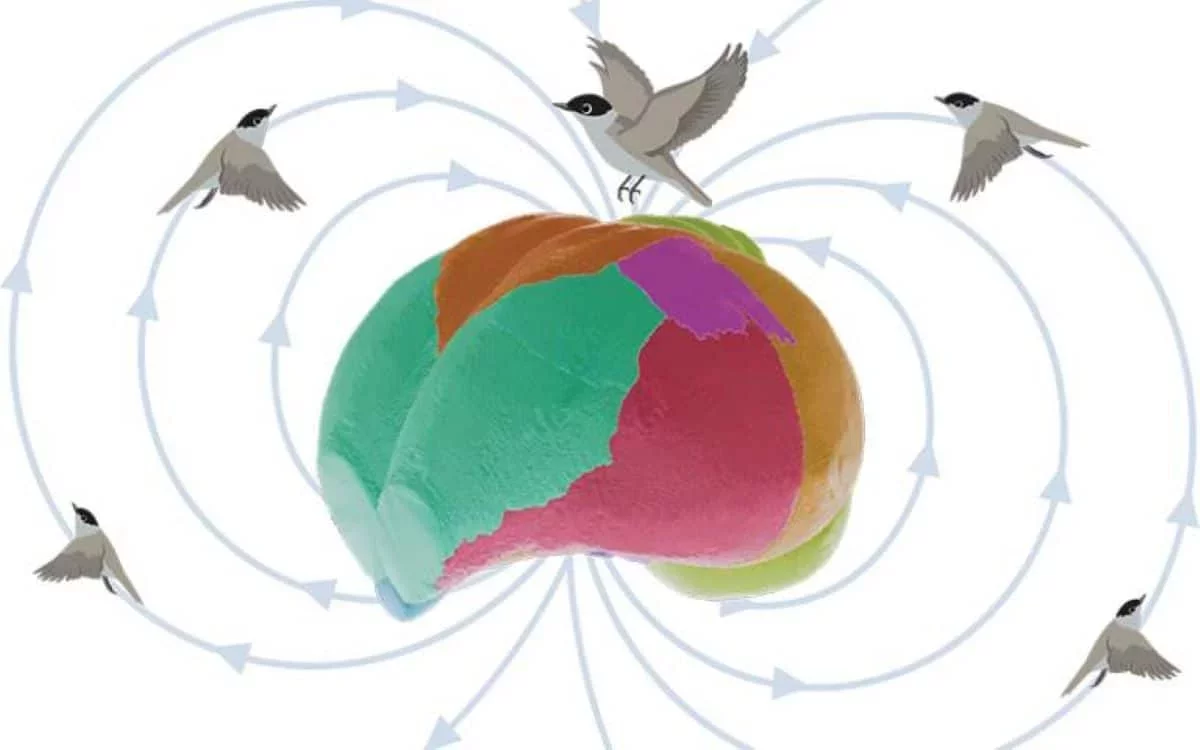
The Eurasian blackcap, a remarkable songbird, embarks on an annual migration that can span up to 6,000 kilometers, showcasing its extraordinary navigation skills. This ability is believed to stem from a unique sense that humans lack--the capability to perceive Earth's magnetic field.
Recent research indicates that these migratory birds utilize a biological compass linked to their vision, allowing them to orient themselves based on the angle of magnetic field lines. However, the underlying mechanisms of this fascinating navigation method have remained elusive until now.
Scientists from the Sainsbury Wellcome Centre at UCL and the University of Oldenburg have developed the first comprehensive, high-resolution 3D digital atlas of the bird brain, specifically for the Eurasian blackcap. This innovative atlas provides a standardized framework for researchers globally, enabling them to compare findings and communicate effectively about avian anatomy.
Decoding Magnetism
While humans experience Earth's magnetic field through tools like compasses, blackcaps perceive it differently. Researchers propose that these birds possess specialized light-sensitive proteins known as cryptochromes, which may initiate quantum-level reactions, granting them a visual-like sense of magnetic orientation.
Dr. Simon Weiler, the study's lead author, explains, "Migratory birds have a true magnetic compass that allows them to actively sense and interpret directional information from the Earth's magnetic field." Unlike a standard compass, this system--referred to as an "inclination compass"--detects the steepness of magnetic field lines, guiding birds toward the poles or the equator.
Mapping the Avian Brain
The creation of this atlas involved advanced techniques, including serial two-photon tomography, which meticulously images and slices the bird brain to develop a detailed map. This effort revealed 44 distinct brain regions, including those responsible for navigation and song.
Notably, the atlas uncovered a direct neural pathway linking the bird's magnetic sensory system to its decision-making center, the nidopallium caudolaterale (NCL). This connection suggests that blackcaps actively integrate magnetic information with other navigational cues, such as visual landmarks and olfactory signals, to make informed decisions about their migratory routes.
Open Science for Future Research
In an exciting move towards collaboration, the research team has made the atlas open-source, hosted on a platform called BrainGlobe. This initiative invites scientists worldwide to contribute their data, fostering a shared understanding of avian brain function and navigation.
As the team sets its sights on the zebra finch for future studies, this pioneering atlas not only enhances our comprehension of bird navigation but also serves as a template for creating similar brain atlases across various species. This development promises to advance neuroscience and enrich our understanding of animal behavior in the years to come.